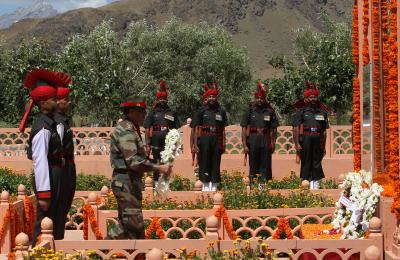

New Delhi, June 29 (IANS) On this day in 1999, the rugged terrain of Drass, now part of Ladakh, witnessed a victory that set the tone for the later triumphs in the Kargil War.
The battle to reclaim ‘Three Pimples’ was to gain a peak of giant significance. It was among the sparks that ignited India’s momentum in the Kargil War, leading to the eventual eviction of Pakistani intruders.
While recalling the Kargil War of 1999, names like Tiger Hill and Tololing dominate the narrative. However, of equal significance were victories at nearby peaks. Among these were Three Pimples and Black Rock, which an Indian Army formation, under the leadership of Colonel M.B. Ravindranath, unfurled the tricolour on this day almost three decades ago.
Colonel Ravindranath, then 40, was later awarded the Vir Chakra for his actions in the Battle of Tololing and Three Pimples. He was commanding 2 Rajputana Rifles that successfully captured many strategic heights along the Srinagar-Leh Highway. He was tasked with the assault on Three Pimples, where he literally led his men from the front in the treacherous climb against heavy enemy fire on the near-impossible terrain. The peak, with three eruption-like formations, towered over 10,800 feet above sea level with hardly a toe-hold available to climb till almost midway.
Beyond that, most of the barren rockface lay almost vertical, a gruelling crawl up the hill – with weapons and rucksacks – open to enemy attacks from adjacent peaks. It was their determination, sacrifice, and leadership that ignited the bravehearts’ resolve to reclaim every inch of their motherland from Pakistani intruders.
Colonel Ravindranath had devised a plan of stealth and surprise, using darkness and sheer determination to scale the heights. His men, inspired by his courage, carried forward the assault and ensured victory.
Many of the bravehearts were martyred and several grievously injured, and their grit and determination earned the battalion a special citation.
Colonel Ravindranath exhibited similar exemplary leadership and valour during the assault on Tololing and Point 4590 as well. During the charge on the night of June 28, a 2 Raj Rif company came under heavy attack. They lost both their officer commanding and their second-in-command.
Colonel Ravindranath then personally assumed command of the company and led the assault, eventually capturing Black Rock and Three Pimples. For his actions during the war, he was awarded the Vir Chakra on August 15, 1999.
He retired from the Army in 2001, settling in Bengaluru, where he established himself in corporate ventures. On April 8, 2018, at the age of 59, he died of a heart attack while jogging at a neighbourhood park.
In remembrance, he stands alongside other heroes of Kargil, many of whom may not be widely known but whose deeds shaped the war’s outcome.
It was in May 1999 that the Pakistani army infiltrated across the Line of Control (LoC), occupying high-altitude positions in Drass, Kargil, Batalik, and Mushkoh. Their aim was to sever the Srinagar–Leh highway, isolate Ladakh, and force India into a disadvantageous negotiation. The intrusions were strategically planned, targeting peaks overlooking supply lines, ridges dominating valleys, and fortified bunkers at high altitudes. Among these, the capture of Three Pimples opened the way for subsequent victorious assaults on Tiger Hill, among other vantage points.
The victory at Three Pimples reminds us that wars are not won in a single battle but through a series of sacrifices, each building upon the other. Colonel Ravindranath’s leadership and sacrifice embody the spirit of the Indian Army – undaunted by adversity, resolute in purpose, and willing to pay the ultimate price for the nation.
--IANS
jb/vd