
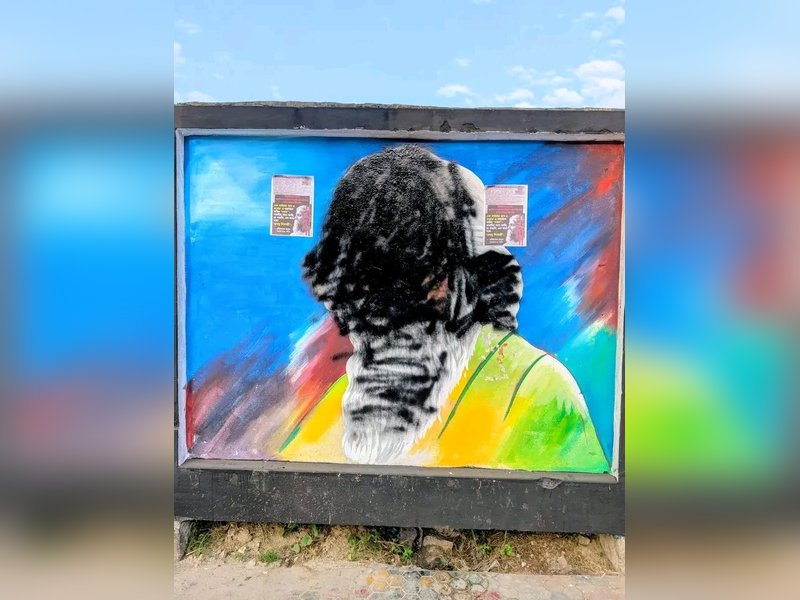
Dhaka, Nov 7 (IANS) In yet another disturbing act of vandalism, miscreants have defaced a mural of Nobel laureate Rabindranath Tagore on the boundary wall of Bangladesh's Khulna Railway Station by smearing it with black ink, according to local media reports.
The incident triggered widespread anger and condemnation among locals, with a cultural activist suspecting the involvement of an organised group.
Confirming the incident, Officer-in-Charge of Khulna Sadar Police Station Lokman Hossain said police received the information on Friday afternoon and initiated an investigation.
"All businesses across the road were closed on Friday, making it difficult to determine who defaced the mural and when," leading Bangladeshi daily Dhaka Tribune quoted the police officer as saying.
Reports suggest that Khulna City Corporation (KCC) took the initiative to paint the murals ahead of Prime Minister Tarique Rahman's scheduled visit to the city.
The murals depicted the 2024 July uprising, the Sundarbans, the historic Sixty Dome Mosque and the jute industry, while also honouring distinguished personalities who enriched the region's art, literature and cultural landscape, including Rabindranath Tagore and Kazi Nazrul Islam.
The wall beside Old Jessore Road featured portraits of prominent figures including Fakir Lalon Shah, artist SM Sultan, Rabindranath Tagore, Kazi Nazrul Islam, former Prime Minister Khaleda Zia, former President Ziaur Rahman and poet Michael Madhusudan Dutt. However, Tagore's was the only portrait found defaced with black ink.
Expressing outrage over the incident, KCC Administrator Nazrul Islam Manju said, "By defacing the portrait, they have exposed their narrow-mindedness and sick mentality."
Shariful Islam Salim, a cultural activist and general secretary of Nattyalok, suspected that an organised group was behind the incident.
"They have carried out similar acts in Dhaka as well. These incidents are being orchestrated deliberately. Those responsible must be identified and brought to justice. This may not stop with Rabindranath; they could target other eminent personalities too," Bangladesh's leading newspaper The Daily Star quoted him as saying.
Emphasising that Tagore's literature and philosophy had shaped generations to uphold free thought, secularism and human dignity, Salim said, "Some young people are being misled into engaging in such disgraceful acts."
Calling Tagore an inseparable part of Bangladesh's cultural identity and a beacon of inspiration, he urged people from all walks of life to raise a united voice against the perpetrators.
The latest incident came nearly a month after a graffiti mural of Tagore outside the Bangladesh Shilpakala Academy in Dhaka was defaced with black ink.
Last month, at least 37 prominent Bangladeshi citizens expressed grave concern over the incident involving the defacement of Tagore mural in the capital, local media reported.
In a statement, the signatories warned that such growing incidents risk emboldening religious extremists and deepening communal tensions in Bangladesh.
They recalled how Pakistani rulers had politically portrayed Tagore as anti-Muslim in the 1960s, comparing that campaign with the recent defacement of his portrait.
"Language, literature, art and culture are indivisible common heritage of humanity," the statement said, emphasising that no religious, geographical or ideological differences should be used to divide cultural traditions.
--IANS
scor/sd/