
New Delhi, Oct 14 (IANS) The Indian Navy's operational activity in 2026 demonstrates a force increasingly capable of operating simultaneously across the Indian Ocean, Indo-Pacific, Mediterranean and Atlantic approaches while exercising with major maritime powers. More significantly, its growing global presence is being matched by indigenous warship construction, maritime surveillance, electronic warfare, unmanned systems and technology development, signalling a transition from an Indian Ocean-focused navy towards a broader blue-water and technology-enabled maritime power.
The Indian Navy's trajectory in 2026 is increasingly defined not by individual exercises, but by the simultaneous scale, geographical spread and technological depth of its engagements, from the Bay of Bengal and Southeast Asia to the Arabian Sea, Mediterranean and Atlantic approaches, Indian naval ships and personnel have maintained an expanding operational footprint while engaging partner navies through exercises, training deployments, capacity-building missions and specialised exchanges.
This pattern matters because a blue-water navy is not demonstrated simply by possessing large warships, it is seen through its ability to deploy, sustain, integrate and operate those forces far from home waters while maintaining interoperability with advanced foreign navies. India's 2026 activities increasingly demonstrate these characteristics.
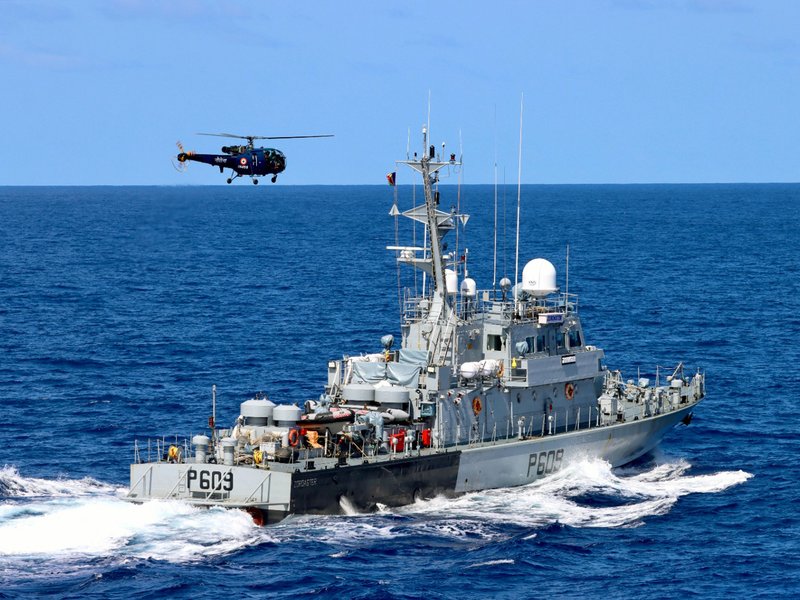
The year began with the Indian Navy's long-range training deployment to Southeast Asia, involving INS Tir, INS Shardul, INS Sujata and ICGS Sarathi, with engagements planned in Singapore, Indonesia and Thailand. The deployment combined officer training with India's wider Act East maritime engagement, the scale became more pronounced with MILAN 2026, which brought together 42 ships and submarines and 29 aircraft, including 18 foreign ships. Conducted from Visakhapatnam, the exercise placed the indigenous aircraft carrier INS Vikrant at the centre of a major multilateral maritime engagement. The significance was not merely the number of participating platforms but India's ability to host, coordinate and exercise with a broad spectrum of foreign naval forces.
India simultaneously expanded its regional maritime-security role through IOS SAGAR, deploying INS Sunayna with personnel from 16 partner nations across the Indian Ocean. It included port calls and training in seamanship, navigation, communications, VBSS, firefighting, damage control and bridge operations. This represents a different dimension of naval power: rather than merely demonstrating combat capability, India is developing the ability to build the operational capacity of partner navies.
The geographical spread of India's 2026 deployments is particularly significant.
In Southeast Asia, the ASEAN-India Maritime Exercise 2026 brought INS Sahyadri and INS Kulish into coordinated maritime activity with ASEAN forces in the Philippines. The sea phase included HADR, VBSS, underway replenishment, cross-deck helicopter operations, vertical replenishment and CASEVAC drills. Such activities test practical interoperability rather than ceremonial naval diplomacy. At the other end of the maritime spectrum, INS Trishul's 2026 deployment demonstrates India's ability to project a frontline combatant into European waters. Trishul participated in the 24th edition of Exercise Varuna with the French Navy at Toulon before continuing its deployment into the Mediterranean and Atlantic approaches, including a port call at Valencia, Spain.
The operational message is important as Indian naval deployments are no longer geographically confined to the immediate Indian Ocean. A frontline Indian frigate can participate in a high-level bilateral engagement with France and then continue operating through European maritime spaces, demonstrating endurance, diplomatic reach and expeditionary flexibility. India's growing interoperability with major naval powers is equally important, Its institutionalised relationships include exercises and engagements with the United States, France, Australia, Japan, the United Kingdom and other advanced maritime forces. The 2026 Indian Navy–US Navy EOD exercise, for example, focused on specialised diving, explosive ordnance disposal, cross-training, equipment demonstrations and emerging technologies.
Meanwhile, India's assumption of command of Combined Task Force 154 under the US-led Combined Maritime Forces represented a particularly significant step. The Indian Navy's leadership of the multinational training task force places Indian officers within a wider coalition framework involving more than 40 nations, Operation Southern Readiness 26-2 subsequently brought together 276 personnel from 27 countries in India, covering maritime law, maritime domain awareness, counter-narcotics, force protection, asymmetric threats and uncrewed systems. This demonstrates that India's maritime role is evolving from participant to organiser, trainer and operational coordinator.
Operational reach, however, cannot be sustained without technological depth. In 2026, India continued to expand its indigenous naval-industrial base. The commissioning of INS Dunagiri, INS Sanshodhak and INS Agray added capabilities spanning surface combat, hydrographic surveying and anti-submarine warfare, INS Mahendragiri, a Project 17A stealth frigate with 75% indigenous content, further strengthened the fleet's combat capability. Technology development is also moving beyond conventional platforms. India contracted for 20 enhanced-capability GNSS jammers with at least 75 per cent indigenous content, providing electronic-warfare capabilities against adversary navigation systems.
Similarly, the leasing of two MQ-9B Sea Guardian systems provides persistent maritime surveillance and ISR coverage across the Indian Ocean, reinforcing the importance of maritime domain awareness in India's wider naval strategy.
The result is an increasingly layered force surface combatants, submarines, naval aviation, ISR, electronic warfare, unmanned systems and indigenous shipbuilding are developing together rather than in isolation.
The most important development in 2026 is therefore not any single exercise. It is the convergence of presence, interoperability and indigenous capability. India is demonstrating that it can operate in different maritime environments while simultaneously maintaining its principal responsibility in the Indian Ocean, Its participation with advanced navies enhances interoperability, its leadership of multinational training initiatives increases strategic influence, and its indigenous technology programmes reduce dependence in critical capability areas.
There are, nevertheless, limitations. A globally dispersed naval presence requires substantial logistics, replenishment, maintenance, fleet availability and sustained investment in submarines, maritime aviation, unmanned systems and network-centric warfare. Global presence must therefore be measured not simply by the number of port calls, but by the Navy's ability to sustain credible combat power over extended distances.
The Indian Navy's 2026 operational pattern points towards a force increasingly comfortable operating across regions rather than within one maritime theatre, from MILAN in the Bay of Bengal and IOS SAGAR across the Indian Ocean to AIME in Southeast Asia and Varuna in the Mediterranean, India's naval diplomacy is increasingly backed by genuine operational activity. The emerging model is therefore broader than traditional blue-water power. India is building a navy capable of combat operations, maritime security, coalition interoperability, capacity building, technological innovation and sustained overseas presence simultaneously. The Indian Navy's significance is increasing extending beyond being the principal maritime force of the Indian Ocean to becoming one of the important globally deployable naval powers of the Indo-Pacific century.
--IANS
scor/as