
New Delhi, Sep 23 (IANS) Many in Ladakh welcomed the August 5, 2019, abrogation of Article 370, bifurcating Jammu and Kashmir into two Union Territories (UTs), a demand they had been pushing for years, realising that they have been ignored in favour of Kashmir.
Ladakh-based climate activist Sonam Wangchuk had then tweeted, "Ladakh thanks @narendramodi @PMOIndia for fulfilling Ladakh's longstanding dream. It was exactly 30 years ago in August 1989 that Ladakhi leaders launched a movement for UT status. Thank you all who helped in this democratic decentralisation."
Soon doubts began to arise.
The reason for dissatisfaction included not being consulted over the abrogation, creation of a UT without a Legislature. It also led to reduction of four MLAs which Ladakh sent to the Jammu and Kashmir Assembly. Finally, they began assuming that they were being exploited to meet the Centre's interest in managing Kashmir. Those who had initially welcomed the move began agitating against it.
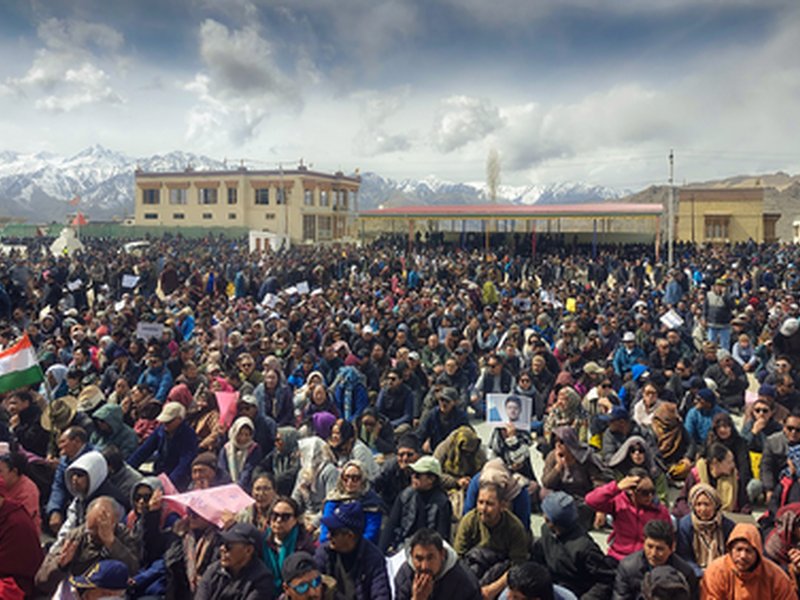
Initial protests began with four demands. The first was converting Ladakh into a state, thereby giving more power to the people. The second was legal protection under the Sixth Schedule to safeguard culture, language and land rights. They also sought job reservations and an additional Lok Sabha seat, thereby providing independent representations for both Leh and Kargil regions.
The Home Ministry, in response to demands created a committee under the Minister of State for Home to examine the complaints as also interact with representatives of the region.
Ladakh was represented by the Leh Apex Body (LAB) and the Kargil Democratic Alliance (KDA).
Sonam Wangchuk, exploiting his public fame and reputation for persistent hunger strikes pushed his way to become a member of the negotiating team and worked to become the face of the protests. He has been seeking a greater political role and recognition.
Protests crossed limits during Sonam Wangchuk's hunger strike on September 24 last year when clashes with the police resulted in four deaths and many injured.
Sonam Wangchuk was arrested and spent six months in jail before being released in March this year. It took some time before talks resumed again.
Sonam Wangchuk had attempted similar tactics of violence when he fasted at the Cockroach Janta Party protest at Jantar Mantar in New Delhi recently, but was instead exploited by the organisers and finally dumped. He now seeks to regain his standing.
The latest round of talks between the Centre and representatives of Ladakh were held on September 9 this year. In this round, it was decided that there would be a UT-level elected body with Legislative, Executive and Financial powers. Its members would be chosen by direct elections, another demand from local negotiators. Delimitation would be done separately for Ladakh and constitutional protection guaranteed for environment, culture, heritage, land and natural resources under a special provision of Article 371, especially designed for Ladakh. This would not be alterable without a two-third majority in the Parliament. However, the Union government was hesitant to guarantee all powers across the board, including law and order, largely because of its location and sensitive environment in the region, mainly Jammu and Kashmir.
Earlier rounds had already delivered reservations in government posts. A domicile framework has also been put in place; five languages notified and a third of Hill Council seats reserved for women. On its part, Ladakh groups were willing to give up their demand for statehood in case the proposal of the Legislative body met their requirements. Thus, progress was evident and major aspects cleared, pending fine tuning. The Centre also released Rs 1.52 crore as compensation for those killed or wounded in the protests of September last year, with families of those killed receiving Rs 15 lakh each.
What remained unsettled was dividing powers between Hill Councils and the new territorial body.
The Centre faced the problem that both claimed the same subjects, forests, land and local administration. Unless these are divided further action cannot be taken. There was no satisfactory common solution provided by the participants.
Hence, they were given eight to ten questions on the subject, the answers of which they should submit after discussing with local residents. This would resolve this issue. These were to be submitted in the next round of talks in October. The Chief Secretary of Ladakh Ashish Kundra even mentioned that the Centre was not keen to impose a model which was unacceptable to the local populace.
However, Sonam Wangchuk began pushing a fake narrative that unless they received an assurance from the Union government that no major decisions would be undertaken by the UT government until the changes were implemented, fresh protests would commence.
It was evident that he was seeking an excuse to instigate violence as he took to social media platform X while visiting Jantar Mantar and said, "Only tea was good in the meeting, otherwise no new decision."
Senior politicians from Ladakh, including former MP Thupstan Chhewang urged Ladakhi leaders to continue building on the progress made thus far, rather than return to the streets, which would push all progress under the carpet.
He described the last meeting as 'positive' and went on to say that "several positive developments and points of consensus discussed during the meeting were not brought before the people". Even the LAB and KDA in a joint statement after the talks mentioned that the meeting "furthered the in-principle understanding" reached in the May and July talks.
It appears that Sonam Wangchuk, who was losing his grip in the movement, especially after being incarcerated for six months, is now looking to re-emerge as the face.
In the next few days, despite all pleading by senior members from Ladakh, Sonam Wangchuk will begin his trademark hunger strike, on some pretext, commence a padyatra to garner support and finally push for violence.
He will exploit the Gen Z in a similar manner as he did in the Cockroach Janta Party protest in Delhi. His ambition is to be the individual who grabs power in the new government, sidelining the current leadership, for which he is willing to do anything, including loss of innocent lives.
It is with this intention that Sonam Wangchuk twisted what was actually discussed and progress achieved, concentrating instead on pushing his concept of 'all or nothing'. Rather than accept that the Centre is interested in resolving issues and moving forward to complete actions under a democratic framework, Sonam Wangchuk is instigating protests and violence.
Sonam Wangchuk's actions would offset negotiations, delaying the process as also impacting governance at all levels.
As long as negotiations continue, elections at Panchayat and Hill Council levels are held up, stopping local development, especially for five newly created districts.
Funds meant for development cannot be allocated and the process slows down. Recruitment, too, cannot commence impacting the youth. What should have led to progress is now being exploited to push political agendas.
It is hoped that the youth of Ladakh understand that the Centre is not seeking confrontation rather collaboration and resolution to satisfaction of locals. They must listen to saner voices and not become involved in ongoing power struggles for power.
(Major General Harsha Kakar (retired) is a former Indian Army officer, strategic analyst and columnist)
--IANS
harsha/khz