
United Nations, May 20 (IANS) India will remain the world’s fastest-growing major economy, recording a rise of 6.4 per cent this year, showing resilience in a world buffeted by Iran war’s fallout, according to the world organisation.
"We have seen structurally very robust growth in India, which has been driven by consumer demand, by public investment, but also by strong performance in services exports”, Ingo Pitterle, the UN’s senior economist heading its Global Economic Monitoring Branch, said on Tuesday.
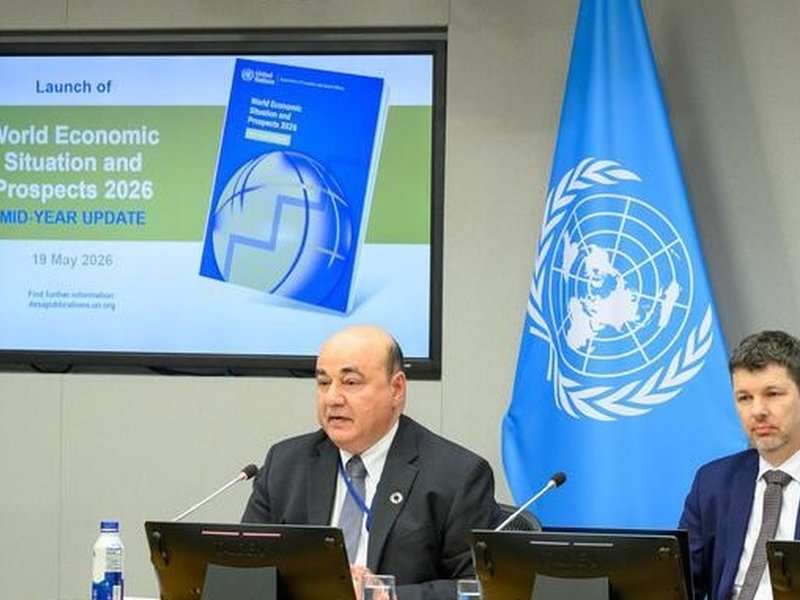
“These main drivers will largely remain intact”, he said, briefing reporters on the mid-year update to the World Economic Situation and Prospects report.
The report downgraded the growth rate of India’s gross domestic product by 0.2 per cent from the projection of 6.6 made in January, but it said that it will catch up to that figure next year.
“Back in January, we were expecting quite significantly more growth for India, so this is a downgrade”, Shantanu Mukherjee, the director of UN’s Economic Analysis and Policy Division, said.
But, he added, “India is a large economy well diversified”, and there have been improvements like some structural changes recently, and improvements in tax revenues."
On dealing with the energy crisis from the closure of the Strait of Hormuz by Iran and its far-reaching impact, the report said, “India’s diversified energy sourcing and structural buffers, including its refining infrastructure, ample foreign exchange reserves, and fiscal space to manage fuel prices, may limit the direct pass-through of higher crude prices”.
The report lowered the world growth rate to 2.5 per cent, also by 0.2 per cent from the projection made in January before the Iran war, which led to Tehran choking off most energy supplies sailing through the Strait of Hormuz.
“The crisis in the Middle East has delivered another major shock to the world economy, testing the resilience of global growth, stoking inflationary pressures and further challenging the prospects for sustainable development”, the report said.
But it pointed out that there is substantial variation among countries and the projections are pulled up “by the performance of large economies, most notably China and India”.
After India, the next fastest-growing major economy is China, clocking a rate of 4.6 per cent this year before dipping to 4.5 per cent next year, according to the report.
Among the major developed countries, the US economy is projected to grow the fastest with a rise of two per cent this year and the next.
The projection for the European Union is 1.1 per cent this year and 1.4 per cent next year.
Despite the high growth rate of India, the overall projection for South Asia is pulled down to 4.6 per cent this year and 5.6 per cent next year by the expected performance of other countries of the region.
India does face problems spawned by the Iran war.
“For example”, Pitterle said, “remittances add to some vulnerability, also a global financial tightening will make monetary policy more complicated".
“We do acknowledge some vulnerabilities and risks going forward, but in our baseline, we assume what I would characterise (as) solid growth of around 6.4-6.5 per cent”, he added.
In the long-range, Mukherji said, “when import costs go up, if these are going into producing your exports, into your manufacturing, your exports could also suffer because import costs are going up”.
When things like freight costs, logistics costs or prices of industrial petrochemicals like naphtha or diesel fuel start increasing, so does the cost for businesses, he said.
"That's why we think that looking not just at the consumer price index but the producer price index is important to get a gauge on what's going on”, he said.
But Mukerjee said, “Like many other large economies, India has some space to manage these, which is why I think we've been saying all along that a lot depends on whether you can manage these shocks within existing buffers before, sort of, your inventories, your fiscal space, et cetera, run out”. “That's crucial”, he added.
--IANS
al/rs