
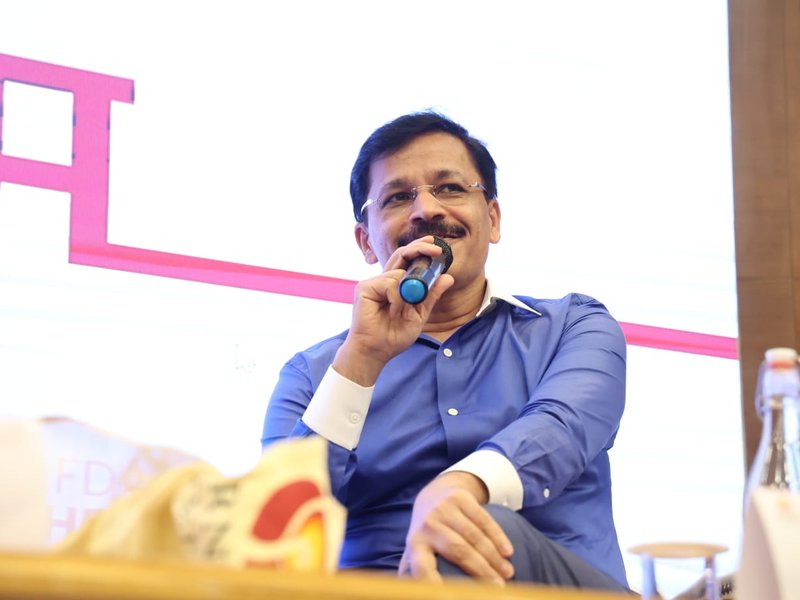
Gandhinagar, Sep 26 (IANS) Maharashtra Food and Drug Administration (FDA) Commissioner Tukaram Mundhe on Saturday said India’s food safety framework has several laws and regulations, but compliance remains a major challenge, arguing that enforcement systems must evolve with new forms of food businesses and changing consumer habits.
Speaking to students at Karnavati University, Mundhe said the central problem is not necessarily the absence of rules but their implementation.
“In food safety, the major concern is that we are not following regulations that are there. Rules do exist. Acts do exist. Regulations are there. By-regulations are there,” he said.
Mundhe said that apart from licensing and registration requirements, several other food safety regulations were not being followed properly, with consequences for public health.
He said India’s food safety regime also needed to respond to businesses that did not exist in their current form when the Food Safety and Standards Act was enacted in 2006.
“E-commerce did not exist then. Today we have e-commerce. We did not have dark godowns then, dark stores; today we have those. We did not have cloud kitchens then; we have cloud kitchens. Do we require legislation and regulation on that?” he said.
Mundhe said suggestions on such emerging issues had been made at the national level through the Central Advisory Committee, of which state food commissioners are members.
“New challenges come; we have to come up with the solutions for that, we have to anticipate and work on that,” he said.
He also described a year-round approach Maharashtra adopted for food safety enforcement during festivals.
"Instead of issuing separate orders before individual festivals, the state had moved to a standing order covering festivals throughout the year," he said.
The framework categorises festivals at state, regional and local levels. It provides for enforcement beginning 21 days before an event, followed by action in the period immediately preceding it, during the festival and legal proceedings after the event.
Mundhe said the approach had already produced results during the Ganesh festival.
He said, "Around 250 to 300 licences or registrations had been suspended during the period for violations including operating without the required licence or registration, while nearly 30,000 kg of food had been seized and destroyed."
He also said food products worth around Rs 10 crore had been seized and FIRs registered in cases where violations were found.
Mundhe said enforcement also needed to become more transparent and technology-driven.
Maharashtra has started a complaints portal through which consumers can register complaints, track them and have them automatically assigned to officers.
“We need to use IT to the best possible extent,” he said, adding that the state was working towards end-to-end digital platforms.
He said the ultimate objective was continuous enforcement rather than ad-hoc action. “If we make SOP with a continuous process, automatic process, it will work. It cannot be an ad-hoc approach,” Mundhe said.
He added that food safety had to involve food businesses, regulators and consumers, with compliance becoming part of everyday food practices rather than something pursued only when enforcement agencies intervene.
--IANS
mys/dan