
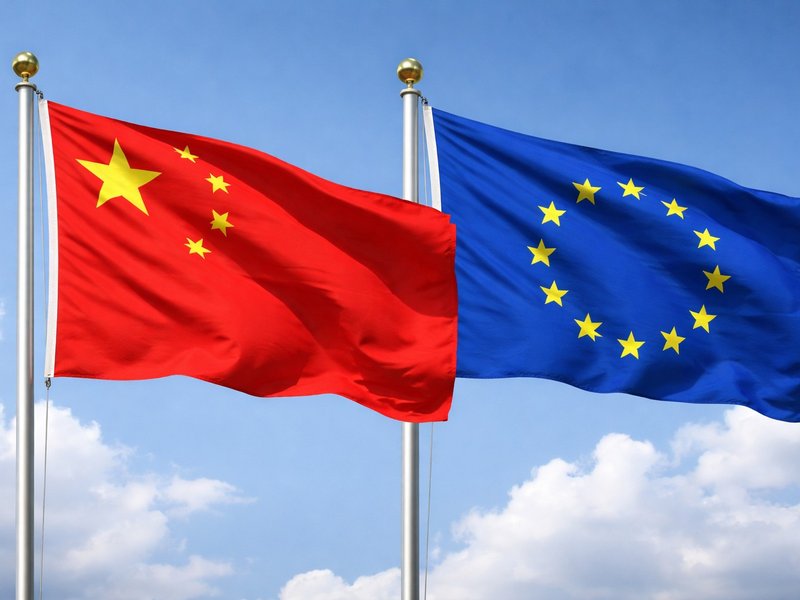
Washington, March 5 (IANS) US lawmakers, foreign leaders, and experts have warned that China is expanding its influence in Europe. They said Beijing uses investment, pressure, and covert tactics, and urged closer US-Europe coordination on technology, supply chains, and security.
At a hearing on “China’s increasing infiltration in Europe” on Wednesday (local time), Congressman Jake Ellzey said Europe must focus on more than Russia. He said the region also faces “the threat of Russia’s war as well as the persistent threat posed by China’s pursuit of hegemony.”
Ellzey said Beijing is using “a suite of overt and covert tools” in Europe. He said China is building “beachheads to manipulate the continent.”
Lithuania’s vice foreign minister, Vidmantas Verbickas, described Beijing’s pressure campaign against his country. He said Lithuania withdrew from China’s “17 plus one format” in 2021. He said Vilnius also permitted “the establishment of a Taiwanese Representative office in Vilnius.”
He said China responded with what he called coercion. “Lithuania as a country miraculously disappeared from China’s customs systems.” He said that export permits were delayed or denied, and that pressure grew on multinational firms.
“The impact was immediate,” Verbickas said. “In the first months, Lithuanian origin exports to China fell by 99.7 per cent essentially to zero.”
He said it was not a trade fight. “This was not a commercial dispute,” he said. “It was a politically motivated pressure designed to change a sovereign policy decision.”
Senator Ruben Gallego warned about technology gaps. He said the West was “slow to respond” on 5G. He said Europe now has infrastructure that “still relies on Chinese vendors.” He said the next risk is “six G.”
Audrye Wong, a nonresident fellow at the American Enterprise Institute, said China’s goals include “to bolster friends and silence critics of the Chinese Communist Party.” She said Beijing also seeks “to undermine transatlantic cooperation and European unity through a divide and conquer strategy.”
Wong said China uses “both coercion and inducements.” She cited “weaponising supply chains.” She said Beijing also tries “to buy support through corrupt investments through bribery, through other covert influence tactics.”
She said China targets many arenas. She said it works across “diplomatic and government realms, business realms, public realms.” She said it mixes “economic information propaganda.”
Wong said the effort can corrode democracies. She said China can make “a dizzying multitude of influence attempts” and then “play a waiting game.” She called it “not just a national security threat.” She said it “corrodes the legitimate functioning of free and open societies.”
Valbona Zeneli, a nonresident senior fellow at the American Enterprise Institute, said Europe has changed course on China. But she warned that the European Union is not unified. She said Europe’s China policy is “a product of a complex negotiation” among EU bodies and “27 member states.”
Zeneli said China’s push in Europe is strategic. She said it aims “to acquire advanced technologies, shape global value chains and build leverage in critical sectors.” She said: “This is not simply commercial gain. This is strategic leverage.”
She said the balance has shifted. She said China supplies “over one fifth of EU imports.” She said Europe faces “a trade deficit exceeding $ 400 billion.” She said Europe’s reliance on Chinese inputs creates “strategic dependencies.”
--IANS
lkj/sd/