
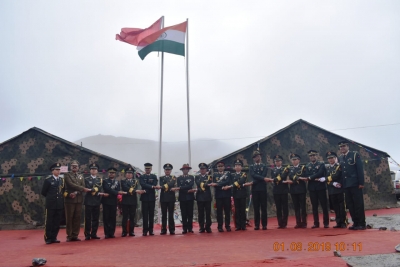
New Delhi, Oct 23 (IANS) The Ministry of External Affairs (MEA) on Friday said that India and China continue to use existing diplomatic and military mechanisms to resolve outstanding issues and "avoid misunderstanding and miscalculation along the Line of Actual Control" (LAC) while emphasising that the situation in the India-China border areas gets disturbed when Chinese forces diverge from established patrolling patterns.
The remarks from MEA spokesperson at a regular bi-weekly media briefing in New Delhi came as a political row erupted over Indo-Tibetan Border Police (ITBP) chief's purported statement that the Army is successfully dealing with a "face-off (with China) in Arunachal Pradesh".
"As we have noted in the past, the situation in the India-China border areas gets disturbed from time to time when Chinese forces diverge from established patrolling patterns. Both sides continue to use existing diplomatic and military mechanisms to resolve outstanding issues and avoid misunderstanding and miscalculation along the Line of Actual Control," said MEA spokesperson Randhir Jaiswal.
"The two sides have also agreed to discuss ways to improve understanding of LAC in appropriate areas for better border management. I would also like to emphasise that the maintenance of peace and tranquility in the border areas is essential for the overall development of bilateral relations," he added.
Last week, the MEA had reiterated that the Union Territory of Ladakh remains an "integral and inalienable part of India" and no amount of denial by the Chinese side can change the fact.
Responding to media queries regarding comments made by the Chinese Foreign Ministry spokesperson on Ladakh, the MEA spokesperson had referred to the Ministry of Home Affairs' statement, which mentioned that the 28 places in Ladakh have been identified with standard place and feature names on the official map of Survey of India. This, he asserted once again, has been done in consultation with the Union Territory of Ladakh and local stakeholders.
"It is reiterated that the UT of Ladakh is an integral and inalienable part of India. No amount of denial by the Chinese side can change this established fact. As for the press release by the Ministry of Home Affairs, GOI, which is being referred to, it is self-explanatory. The announcement mentions that the twenty-eight (28) places/features located in the UT of Ladakh have been identified with standard place and feature names on the official map of Survey of India, and it has been done in consultation with the Union Territory of Ladakh and local stakeholders. Identifying these places formally on the Survey of India map of UT of Ladakh is aimed at facilitating their accurate recognition and better awareness among the public at large," he said.
The MEA's response came after Chinese Foreign Ministry spokesperson Mao Ning on October 13 opposed India's Ministry of Home Affairs identification of 28 places of Ladakh by standard place and names on the official map, terming it as "illegal and void."
Earlier this month, the Centre identified 28 places/locations in Ladakh by standard place and feature names on the official map of the Survey of India in order to recognise their geographical significance and for awareness of the general public about their exact location.
In September, External Affairs Minister (EAM) S Jaishankar, during his visit to New York, said that India's relationship with China has improved from the depths of their border stand-off, but the condition of the frontier will continue to determine how far the two countries can normalise ties.
EAM Jaishankar said the India-China relationship was better than it had been in 2025, and better still compared with 2024. He cautioned against treating that recovery as a fundamental change in the relationship.
"I don't think it's structural change so much as a recovery from how far ties had deteriorated, he said. After the events of 2020 and the prolonged border stand-off, normal contact between the two countries had been severely affected.
Trade continued, but official exchanges, visas and flights were disrupted, he said. As the stand-off eased, some of those contacts began to return. EAM Jaishankar described that as a natural consequence of stabilisation rather than proof that the underlying issues had disappeared.
"A dip in our relationship actually doesn't help either of us," he said, adding that third parties could benefit from such a situation.
In September, Prime Minister Narendra Modi met Chinese President Xi Jinping on the sidelines of the 18th BRICS Summit in New Delhi, where the two leaders emphasised that "differences should not become disputes" and reaffirmed that both countries should take a strategic and long-term perspective of their ties.
During the meeting, PM Modi had stressed that peace and tranquillity in the border areas remain an essential basis for the continued development of bilateral relations.
--IANS
/as