
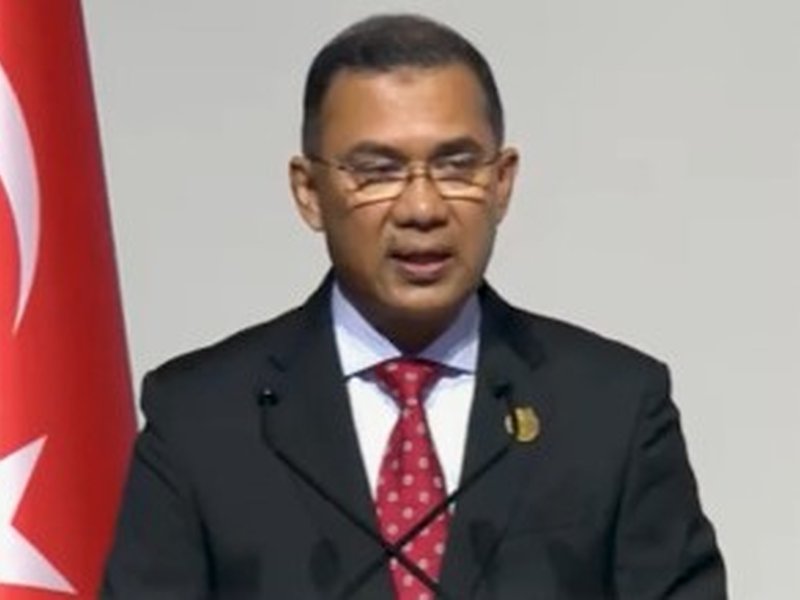
New Delhi, Nov 21 (IANS) Bangladesh Prime Minister Tarique Rahman’s remarks on Friday, implying India’s hand behind rising violence in his country, coincidentally came a day after he met with Jamaat-e-Islami chief, now Leader of the Opposition, Shafiqur Rahman. The meeting was described in several media reports as an attempt to forge greater unity against the now-banned Awami League.
The meeting took place days before Awami League chief and former Prime Minister Sheikh Hasina’s much-anticipated arrival in Dhaka.
Interestingly, the Jamaat leader advised Rahman “to hold dialogue with political parties to uphold anti-fascist unity and uproot fascism from the country”, reported Bangladesh ‘Prothom Alo’.
Interestingly, earlier this month, reports emerged that the ruling Bangladesh Nationalist Party (BNP) was planning to hold talks with political parties that participated in the 2024 protests against the then government, with the stated aim of “preserving unity” among forces opposed to the Awami League.
“However, the BNP will not invite parties affiliated with the Jamaat-e-Islami-led alliance. The talks may take place in late November or December,” it added.
Separate reports indicated that in the absence of the Awami League from the country’s political stage, once allies, the BNP and Jamaat appeared to be drifting away since the time of the elections.
Relations have increasingly become bitter, especially on the issue of implementation of the July National Charter and the verdict of the referendum, observed commentators.
The National Charter, drafted after the 2024 mass uprising and endorsed by most major political parties, set out a broad agenda for state and constitutional reforms, including measures to strengthen judicial independence, rebalance executive power, and expand democratic accountability.
In the national referendum held alongside the February 2026 general election, the charter was approved by a majority of voters.
While the BNP argues that the charter's reforms should be implemented through constitutional amendments passed by Parliament, the Jamaat insists that voters specifically endorsed a separate Constitution Reform Council and broader structural reforms beyond ordinary parliamentary amendments.
This disagreement over the mechanism of reform has turned into a significant political dispute lately. Reports have even cited instances where each has been accusing the other of secret understandings with the Awami League.
The BNP has apparently been trying to distance itself from the Jamaat to gain wider support among secular and international communities, but the move is said to have led to some disagreements within the party.
Meanwhile, Bangladesh is experiencing a period of renewed political turbulence, with rising street violence, economic discontent, and intensifying competition among the country's major political forces.
According to reports, paramilitary forces were mobilized across the country as violence, crude-bomb attacks, and political clashes spread to multiple districts. Yet, some media analyses suggest that the government is trying to avoid an aggressive security crackdown, fearing such action could invite comparisons with past episodes and unpleasant repercussions.
The Jamaat itself remains mired in controversy in Bangladesh politics because of its opposition to the country's independence during the 1971 Liberation War.
The party and several of its leaders were accused of collaborating with the Pakistan army. Some of its senior leaders were later even convicted by Bangladesh's International Crimes Tribunal for war crimes committed during the conflict.
This legacy has contributed to Jamaat's long-standing political alienation, where its critics view the party as an unreliable partner because of its radical views on religion, shifting political alliances, and the enduring mistrust from its 1971 stance.
Yet, major parties have repeatedly found electoral value in cooperating with it, where the Jamaat’s organisational strength and electoral influence have made it a partner that larger parties have periodically embraced when coalition-building served their interests.
Media narratives on the latest developments portray the current regime as under strain amid Awami League mobilisation even under a ban, labour unrest, and growing Islamist pressure, and seeking assurance from a powerful and influential adversary to contain another.
--IANS
jb/srk/skp