
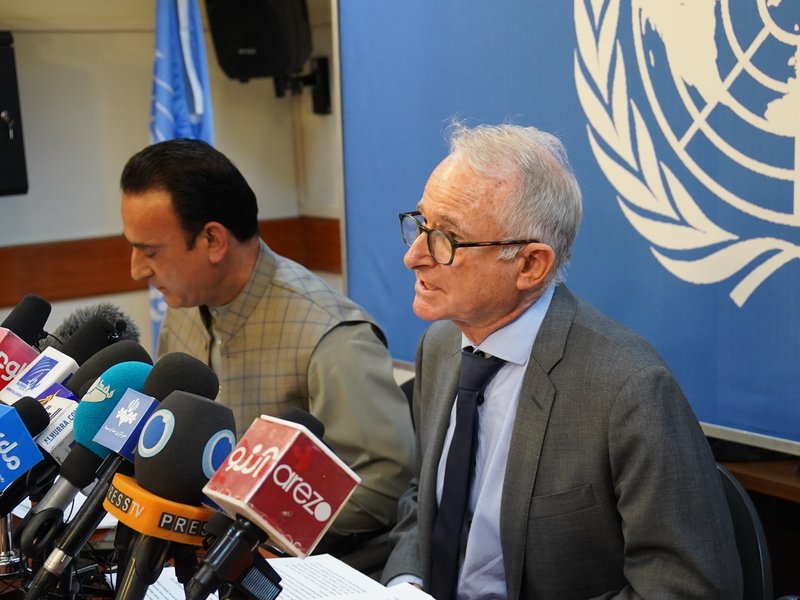
Kabul, May 3 (IANS) UN Special Rapporteur on the situation of human rights in Afghanistan Richard Bennett has demanded immediate and unconditional release of detained journalists in Afghanistan, local media reported on Sunday.
In a statement marking World Press Freedom Day on Sunday, Bennett called on Taliban to ensure that journalists can do their work freely without fear of arrest, threats or harassment.
He stressed that press freedom has worsened significantly since Taliban seized power in Afghanistan, with independent reporting increasingly restricted under a hostile environment, Afghanistan's leading news agency Khaama Press reported.
"At least 4 journalists and media workers continue to be detained in Afghanistan. I call for their release and the release of all other people arbitrarily detained in Afghanistan. No time is better than today for this, as 3 June is World Press Freedom Day," Bennett posted on X.
He stated that journalists now function under constant pressure and ordinary reporting can lead to reprisals, especially on issues related to women’s rights and governance.
Bennett stated that people speaking to the media face intimidation, surveillance, and detention, further affecting the flow of reliable information.
Bennett further stated that female journalists in Afghanistan face compounded barriers, mobility restrictions, dress codes, and shrinking opportunities, resulting in many leaving their profession, Khaama Press reported.
Meanwhile, Afghanistan has been ranked 175th out of 180 nations in the 2026 World Press Freedom Index, according to data from Reporters Without Borders (RSF).
Afghanistan's overall score increased from 17.88 in 2025 to 19.51 in 2026, indicating better press freedom. Despite the slight improvement, Afghanistan has been ranked among the worst-performing nations, Afghanistan-based Amu TV reported.
RSF evaluates press freedom on the basis of five indicators - political, economic, legislative, social and security -- each analysing a different dimension of the media landscape. The political indicator, which analyses government influence over the media and editorial independence, ranked Afghanistan 158th in 2026, in comparison to 163rd in 2025.
The economic indicator, which assesses the financial condition for journalism including funding, advertising and sustainability of media houses, remained unchanged at 165th in both years.
The legislative indicator, which analyses laws and regulations impacting press freedom, ranked Afghanistan at 178th position in 2025 and 2026.
The social indicator, which evaluates societal pressures, discrimination and the ability of journalists to function freely within the cultural norms, ranked Afghanistan at 175th rank in 2025 and 2026.
The security indicator, which evaluates risks like violence, detention and threats against journalists ranked Afghanistan at 177th spot in 2026 in comparison to 175th in 2025.
RSF noted that the figures showcase that media environment has reshaped after Taliban seized power in Afghanistan on August 15, 2021.
It said, "The takeover sounded the death knell for press freedom," adding that media organisations now need to broadcast government-controlled information in an environment “devoid of pluralism and dissenting voices.”
According to the agency, 43 per cent of media houses closed within three months of Taliban's return to power. Over two-thirds of Afghanistan's roughly 12,000 journalists have left the field, Amu TV reported.
Women journalists have also been impacted, with eight out of 10 not working anymore. According to the RSF, the political and legal environment has increased control over the media in Afghanistan, with journalists receiving orders from several state bodies, including ministries, the intelligence service and institutions monitoring public conduct.
--IANS
akl/pgh