
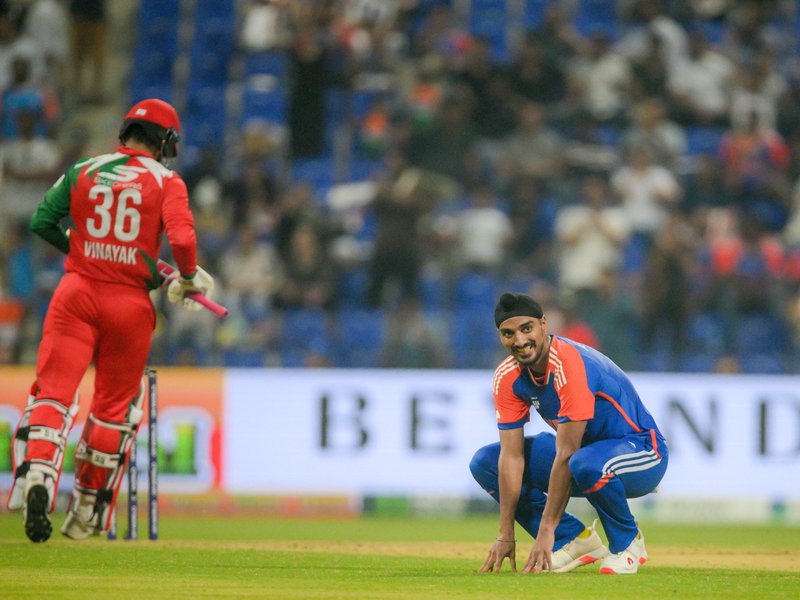

New Delhi, Jan 25 (IANS) Vinayak Shukla’s rise in international cricket has been anything but conventional. Growing up in the busy lanes of Kanpur in the early 2000s, Shukla learned the game the way many Indian cricketers do, on the streets, where adaptability, sharp reflexes, and instinct matter more than textbook technique.
That street-honed style would later define him, even as it led to him being overlooked in age-group cricket, echoing the early struggles once faced by the legendary Mahendra Singh Dhoni.
Despite early promise spotted at the PAC Cricket Academy by coach Laikchand Rajput, Shukla found himself repeatedly ignored at higher junior levels due to perceptions around his technical limitations. A severe hamstring injury in 2018 sidelined him for nearly seven months, becoming a defining moment in his career.
After a brief overseas opportunity in Kenya was cut short by the COVID-19 pandemic, Shukla eventually found his footing in Oman. Today, he stands as one of the team’s most reliable performers, a clinical wicketkeeper, instinctive batter, and the vice-captain of the national side heading into the World Cup.
In an exclusive conversation with IANS, Shukla reflected on his journey, learnings from Suryakumar Yadav and Hardik Pandya, and Oman’s T20 World Cup ambitions.
IANS: From the streets of Kanpur to a near move to Kenya and eventually representing Oman, how would you describe your journey?
VS: My journey has been filled with ups and downs. I started playing in Kanpur, and, like any athlete, I wanted to represent my country, but the challenges I faced in India made it difficult. Fortunately, I got the opportunity to represent Oman, and I thank God for it. It’s truly an incredible honour to represent a country like Oman, and I feel proud and privileged to wear that red jersey.
IANS: Is it true that when you started wicketkeeping in Oman, you were not handed the gloves immediately?
VS: When I came to Oman, there were about four keepers in the same team, and since everyone is a good batter and contributes their part, we typically have only one wicket-keeper. My captain was also a wicket-keeper, so I didn't get many chances to keep during matches or practice because if I kept, the captain wouldn't sit out of the eleven. I prefer fielding and doing my part that way. For the first two years, it was really tough to get out of those gloves because I didn't have the opportunity to keep. It's a similar story to Dhoni's; I had to wait a long time before getting the gloves. I spent quite a long time just fielding for my team, but I must say the credit goes to the Oman coaching staff, who finally gave me one opportunity and trusted me with the gloves.
IANS: How has Oman’s preparation for the World Cup been so far?
VS: This time, our preparation has been quite focused, with a strong lead-up camp at our home base. Our main emphasis has been on fitness and mental readiness. Over the past few months, we've been thoroughly preparing for the World Cup, and it’s a significant tournament for us. Our focus remains on refining technical skills and strengthening mental resilience.
IANS: How do you assess the squad heading into the tournament?
VS: I believe this squad is an ideal blend of experience and youth, with three players having participated in numerous international events, while the younger players are getting their first opportunity. The experienced players will bring calmness to the team, while the youngsters will add fearlessness. It’s great to have this mix of youth and experience. I also think our main focus is on bowling, which we see as our strength.
IANS: During the Asia Cup, you had interactions with several Indian players, including a long conversation with Suryakumar Yadav. What stood out?
VS: It was a great opportunity for all of us to interact with Suryakumar Yadav and other team members. When we talk about Surya, he's been really polite with us and has taught us that the conversation is only about the mental aspect: how to take the game deep, understand the game well, and perform well under pressure. Surya is not just a good batter but also the captain of the Indian team, so he knows every aspect of the team. The way he guided us and motivated us has been really amazing. We have also been to the Indian dressing room to interact with a few players, and we asked some of them how they understand the game, how they handle pressure, and how they perform in clinical situations.
IANS: Did you receive any specific advice from other Indian players?
VS: I talked with Hardik Pandya. He's such a polite guy, and he helped me understand the game because he plays at the same spot where I play. So we talked about him and how he sees the game. He was pretty clear about it, saying never to look for the opponent or the bowler, but always keep an eye on the scoreboard. Whenever you see a scoreboard, it will give you a clear picture of the match and what you need to do in the coming overs. That will help you make a plan that will be really helpful for you and the team.
IANS: What were the biggest learnings from the Asia Cup?
VS: For most of our team members, this was their first global event, as we are quite young aside from a few experienced players. Participating in such a large-scale event has been truly amazing. Now, the players are well-prepared, understanding how to handle pressure and execute key movements that can turn the game. Our current focus is on smaller details where we can make a difference and influence the outcome. This mainly involves planning and strategising for matches against stronger opponents. While mistakes can be overlooked when playing against lesser-known or associate countries, they are unforgivable against Test-playing nations like India and Pakistan. This experience has been a valuable learning opportunity, boosting our confidence as we transition from the Asia Cup to the World Cup.
IANS: As vice-captain, how do you view your leadership role?
VS: I believe leadership always involves responsibility, but to me, it's more of a privilege than pressure. My role is clearly to support the captain and mentor the younger players. I aim to ensure everyone is in a good mindset and well-prepared before they step onto the ground. If someone has thoughts or strategies about the game, I want them to feel comfortable sharing them with me. My goal is to create an environment of openness and support that helps my team secure victories.
IANS: This will be your fourth World Cup. What changes this time around?
VS: I believe experience plays a significant role, and this time we're smarter with our matchups, clearer with our game plans, and more adaptable to conditions during play. It's not just about tactics but also about focusing on the mental aspect and paying attention to small details, such as game awareness, finishing, and recognising moments to shift the momentum. Ultimately, it's about combining our intensity, experience, and fearlessness to support the team.
IANS: How do you think that the experienced players on the side help the youngsters cope with losses and move ahead?
VS: Winning and losing are part of the game. When we win, it's a reason to celebrate everyone’s success, but losing can be difficult. For seniors, the key is how they communicate with juniors to improve outcomes. We aimed to create an environment where everyone, especially youth, feels comfortable approaching us with suggestions on how to enhance results.
IANS: Who do you see as Oman’s toughest opponent in the group?
VS: Honestly, I feel every team in our group is challenging because everyone is a Test-playing nation, and we are the only associate country. But I feel it's a blessing in disguise for us. If we are going to win, I hope we are going to win a couple of games from here, and then it's going to be like we beat a Test-playing nation, which is going to be a big thing for the boys because it's our first World Cup. If we are going to beat some Test-playing nations, then it will be really amazing. In a T20 game, it's a pretty fast game, and you know every team has their chance to win the game, so you can't just say everyone is out of your hands to win a game. But it will be within reach if you play well, put in all the effort, and click all the boxes. You will definitely win. We would like to win every game we are going to play, but if we win a game against Australia, it would be a big deal because Australia is a very big team and everyone knows the kind of cricket they bring to the world, so it would be really amazing if we beat Australia.
IANS: You’re returning from injury just before the World Cup. How important was rehab in this phase?
VS: When you get injured, it's a tough time because you are out of the ground and you can't move your body to get back into the ground and do the things you love most. Rehab obviously tests my patience, but it took me about 2 months to get back on the ground. All credit goes to the medical staff, especially our physio and our trainer, Shiva. These guys put a lot of effort into getting me back onto the ground, and they make sure, not just physically but also mentally, that I am fit before I move out of that rehab phase and get back onto the ground. Right now, I am feeling pretty well and pretty fit, with clarity about my plans, and I am in a good mental state to go to the World Cup.
--IANS
vi/hs/