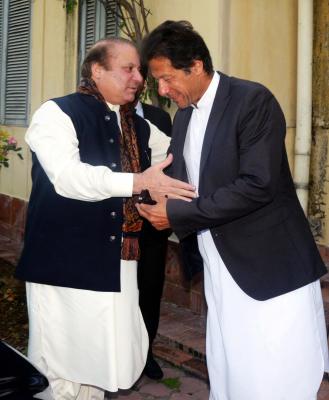
Islamabad, Feb 24 (IANS) Pakistan's history showcases that political imprisonment is a recurring instrument of power used by civilians and dictators and justified in the name of accountability or national security. The names of Pakistan's leaders who have been imprisoned have changed, however, the pattern has remained same, a report has highlighted.
"Those who deny freedom to others deserve it not for themselves (Abraham Lincoln); this warning resonates uncomfortably in Pakistan’s political history, with political imprisonments becoming a recurring instrument of governance. Barely a year after independence, Pakistan witnessed its first political imprisonment, when in 1948 Bacha Khan – a prominent Pashtun leader – was arrested and charged with sedition for allegedly conspiring against the state," Muhammad Mustafa Arif wrote in 'The Friday Times'.
The political incarceration was most deeply rooted in Pakistan under the military rule Zia-ul-Haq between 1977-1988. One of the most severe phase of political repression was witnessed during this period, with the imprisonment and eventual execution of Zulfikar Ali Bhutto and arrests of political workers during the Movement for the Restoration of Democracy. Bhutto was convicted for alleged killing of a political opponent, a charge that resulted in his execution in 1979.
In 2024, Pakistan's Supreme Court admitted that fair trial and due process was not followed in his case. Pakistan's then-Chief Justice Qazi Faez Isa stated, "We must, therefore, be willing to confront our past missteps and infallibility with humility in the spirit of self-accountability and as a testament to our commitment to ensure that justice shall be served with unwavering integrity and fidelity to the law." At the time of Isa's statement, Pakistan's former Prime Minister Imran Khan was arrested on August 5, 2023, along with other senior leaders of Pakistan's Tehreek-e-Insaf (PTI).
"The contrast is difficult to ignore: does institutional introspection extend equally to the opposition, or only safely to the government? If justice is to be served with “unwavering integrity,” it must not depend on whether one sits on the treasury benches or in opposition; otherwise, the promise of accountability risks becoming retrospective symbolism, while those currently out of favour endure incarceration, deprivation, and the slow erosion of their fundamental rights. However, it must also be acknowledged that Imran Khan was no saint in office," Arif wrote in 'The Friday Times'.
The writer mentions further that during Imran Khan's tenure in office from 2018-22, the same machinery of incarceration was used against his political opponents. Several cases by the National Accountability Bureau (NAB) and other prosecutions were filed against senior leaders of the Pakistan Muslim League-Nawaz (PML-N) and Pakistan Peoples Party (PPP). Prominent PML-N and PPP leaders, including Nawaz Sharif, Shehbaz Sharif, Maryam Nawaz and Asif Ali Zardari were arrested and faced conditions that their supporters termed humiliating and punitive instead of judicially necessary.
Nawaz Sharif's health condition deteriorated during his detention and he suffered multiple heart and kidney ailments and had complaints of restricted access to his personal doctors. Maryam Nawaz claimed that surveillance cameras were installed in her prison cell, including in the bathroom and she was permitted to meet her father only once a week despite being in the same prison. Meanwhile, Shehbaz Sharif, a cancer survivor suffering from severe back pain was reportedly made to sleep on the floor during his early days of detention. As of now, Imran Khan has remained in prison for more than 900 days, with recent reports raising serious concerns about his right eye.
"Pakistan’s history shows that political imprisonment is not the excess of one regime but a recurring instrument of power, deployed by civilians and dictators alike, and justified in the language of accountability or national security. From Bacha Khan to Zulfikar Ali Bhutto, and from Nawaz Sharif to Imran Khan, the names change, but the pattern remains," Arif concluded.
--IANS
akl/as