
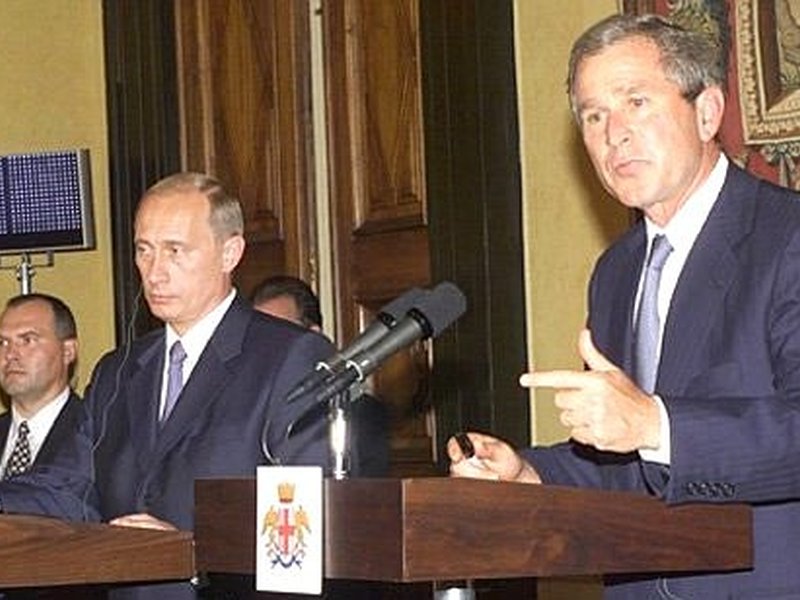
Washington, Dec 25 (IANS) Long before Russia’s confrontation with the West hardened into open hostility, President Vladimir Putin privately warned U.S. President George W. Bush that NATO expansion into Ukraine and Georgia would create permanent instability, according to newly released transcripts of their meetings from 2001 to 2008.
The documents, released by the National Security Archive, show Putin repeatedly arguing that NATO’s eastward expansion posed a direct threat to Russia’s security and would lead Moscow to resist by political and strategic means.
During their final meeting in April 2008 in Sochi, shortly after the NATO summit in Bucharest, Putin told Bush that Ukrainian membership would generate “long-term confrontation” and warned that Russia would rely on anti-NATO forces inside Ukraine to block the alliance’s advance.
“Russia would be creating problems there all the time,” Putin said, arguing that NATO membership would split Ukraine internally and bring military systems dangerously close to Russia’s borders.
Putin described Ukraine as an “artificial country” created during the Soviet era and said a large portion of its population viewed NATO as a hostile organisation.
He warned that deploying Western military infrastructure near Russia would trigger countermeasures.
Bush listened but made clear he would not alter U.S. policy. Even so, he expressed admiration for Putin’s bluntness, telling him, “One of the things I admire about you is you weren’t afraid to say it to NATO… It was a good performance.”
Putin, in the transcripts, is expressing his strong opposition to NATO expansion into Georgia, warning that it could encourage conflict in regions such as Abkhazia and South Ossetia. He predicted guerrilla warfare and instability if Georgia attempted to resolve internal disputes under NATO’s “military umbrella.”
For Indian readers, the documents offer rare insight into Russia’s worldview — one that New Delhi has had to factor into its strategic engagement with Moscow.
These documents show that Putin consistently framed Western military presence near Russia’s borders as an existential threat to his country. At the same time, he portrayed Russia as defensive rather than aggressive.
As per the transcripts, Putin clearly articulated his views to Bush years before his military actions, which runs counter to the American claims that Russian actions were sudden or unpredictable.
Bush, while disagreeing, acknowledged Putin’s logic and sought to manage disagreements through transparency and dialogue, particularly on missile defence and strategic stability.
--IANS
lkj/dan