
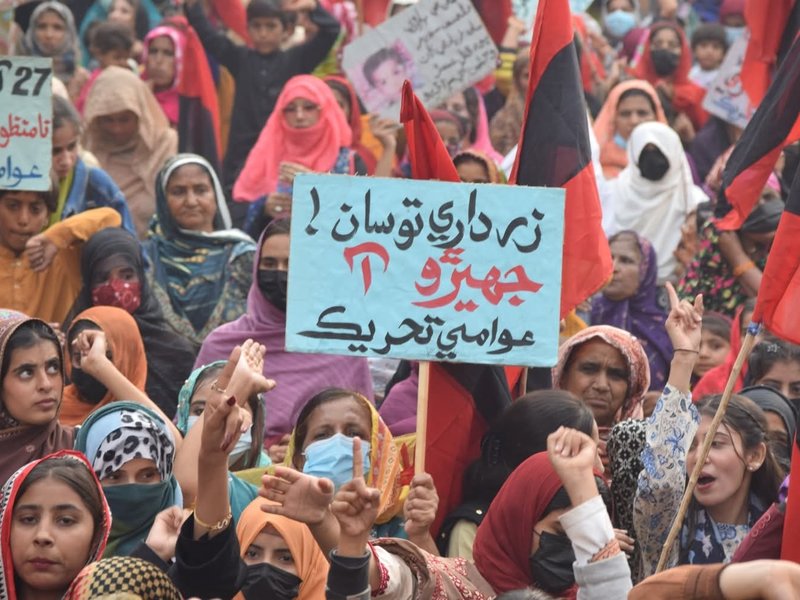
Islamabad, Dec 22 (IANS) Thousands of people participated in the 'Save Sindh's Existence and Resources March' from Bakrani Road to Jinnah Bagh Chowk in Pakistan's Larkana despite the imposition of Section 144 by the authorities and what organisers of the protest described as fake FIRs, local media reported on Monday.
The march, organised by Awami Tehreek and Sindhyani Tehreek on Sunday, was held to protest against the 27th Constitutional Amendment, proposed corporate farming projects, development of new canals and dams on the Indus River, alleged stealing of Sindh's resources, and the spread of bandit rule, Pakistan-based leading daily The Express Tribune reported.
While addressing the gathering, Awami Tehreek Central President Advocate Vasand Thari said that the parliament had been reduced to a rubber stamp and all major decisions related to the nation were being taken outside Pakistan.
He criticised the 26th and 27th Constitutional Amendments, corporate farming projects, and the role of the Special Investment Facilitation Council (SIFC), terming them unconstitutional and harmful for Sindh.
He demanded a judicial probe into the supply of weapons to bandits and action against their alleged patrons.
Earlier this month, Jeay Sindh Muttahida Mahaz (JSMM) chairman Shafi Burfat urged Prime Minister Narendra Modi to raise the issue of what he described as Pakistan's "extremist-controlled nuclear arsenal" at international forums and draw global attention to Islamabad's state-sponsored terrorism and radicalisation.
In a detailed appeal, Burfat had said, "With deep respect and an unshakable commitment to peace, dignity, and regional stability, I submit this comprehensive appeal on behalf of the people of Sindh, an ancient civilisation, a distinct nation, and a people who today stand at the frontline of suffering under Pakistan's militarised, extremist-driven, and structurally artificial state system."
"This appeal is not merely a political statement. It is a warning. It is an alarm for humanity. It is the voice of a nation struggling to survive under an oppressive, radicalised, and dangerously unstable state," he added.
Burfat had argued that Pakistan's Sindh province faces a grave existential threat under the country's "extremist, militarised, and fundamentally corrupt state structure".
With Pakistan's "radicalised, jihadist-influenced military elite" controlling nuclear weapons through opaque and irresponsible command systems, he warned that the country represents not only a danger to Sindh but a destabilising force for the wider region and the world.
Expressing concern, Burfat stated that the escalating nuclear danger under Pakistan's "radicalised" army is no longer about whether extremist groups might seize nuclear weapons. Instead, he claimed, "the alarming truth is that extremism now occupies the highest command of Pakistan's military structure itself".
--IANS
akl/sd/