

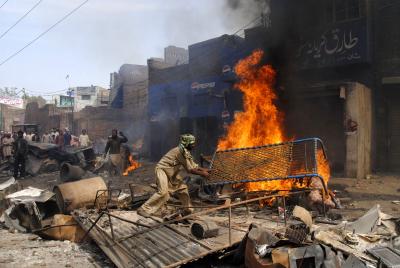
Islamabad, Jan 16 (IANS) Syndicates, which have entrapped hundreds of people in blasphemy cases for refusing extortion demands continue to remain active in Pakistan, a recent report has cited. It highlighted that the National Commission for Human Rights in Pakistan has said that more than 450 people, mostly men, have been entrapped over the years, and that 10 of them were Christians with at least five of those arrested dying in custody.
"In July, the Islamabad High Court in the national capital ordered the federal government to form a commission to investigate the misuse of blasphemy laws while hearing a petition from 101 affected families. However, an appellate bench later suspended the investigation in an interim order," reported the Union of Catholic Asian (UCA) News, a leading Asian independent Catholic media service.
In several cases, it added, officials of the Cyber Crime Wing of the Federal Investigation Agency, Pakistan’s premier law enforcement agency, were also involved in framing false charges.
The report cited several case studies, including that of 33-year-old rickshaw driver Amir Shehzad, which exposed the activities of the blasphemy gangs.
Shehzad disappeared from his home in Pakistan's Lahore after leaving to collect a parcel from a man following a call. Four days following the disappearance, the FIA told the family that Shehzad had been arrested for sharing blasphemous posts on Facebook.
"The distraught mother visits Shehzad every Tuesday. He told her that several inmates were being held on similar charges after being 'entrapped', just as he had been. Shehzad’s family and rights groups say he is one of many victims of a syndicate commonly known as the 'blasphemy gang', which traps mostly young men in blasphemy allegations for vested interests," UCA News reported.
It mentioned that, in early 2024, a report by the Punjab Police Special Branch confirmed the existence of such a syndicate, which entrapped hundreds of people in blasphemy cases for refusing extortion demands.
Several reports have recently highlighted how Pakistan has intensified campaign against minorities by using its highly controversial and widely-criticised blasphemy laws.
Last month, a Pakistani court sentenced a member of the Ahmadi community to life imprisonment for using the title “Hafiz”, meaning “one who knows the Quran by heart,” and for distributing the “Tafsir-e-Saghir,” a collection of Quranic translations and commentary respected within his community.
“On 24 December 2025, an Additional Sessions Court in Lalian, Punjab, delivered a verdict that should shame any legal system claiming to uphold justice. Mubarak Ahmad Saani, an Ahmadi Muslim, was sentenced to life imprisonment under Pakistan’s blasphemy laws. His crime was not desecrating the Quran, not insulting Islam, not inciting violence or hatred, but calling himself a 'Hafiz', and distributing a book of Quranic translation and commentary revered by his community,” a report in online magazine ‘Bitter Winter’ detailed.
“The court’s decision criminalises reverence, punishes piety, and weaponises theology to persecute a man whose only offence was to practice his faith with sincerity and devotion — a faith that Pakistan’s legal machinery has systematically declared illegal,” it added.
According to the report, in a ruling that defies both “legal logic and theological humility”, the court conducted a doctrinal analysis of Ahmadi “heresies,” declaring the book a “defiled, desecrated translation of the Holy Quran,” and invoking a provision of Pakistan’s blasphemy law that prescribes life imprisonment those who burn, tear, or otherwise desecrate the Quran.
“But Saani did none of these things. He did not destroy the Quran. He circulated it. He revered it. He offered a translation and commentary that his community has cherished for decades. This is the perverse genius of Pakistan’s blasphemy laws. They punish interpretations and police theology. And when applied to Ahmadis, they become a tool of religious apartheid—a system in which the Sunni majority dictates not only who may call themselves Muslim, but who may read, translate, and honour the Quran," it mentioned.
--IANS
akl/as