
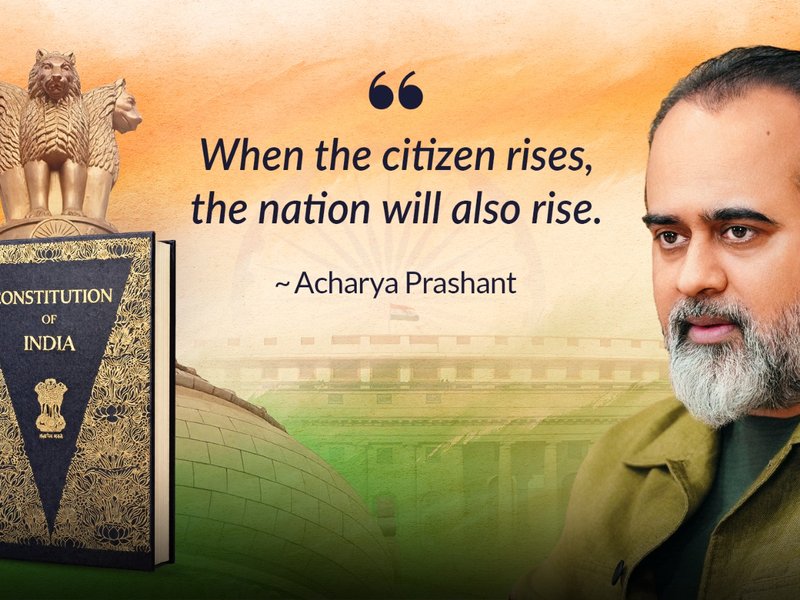
New Delhi, Jan 25 (IANS) On the occasion of India's 77th Republic Day, philosopher and author Acharya Prashant said that the idea of a Republic cannot be reduced to a Constitutional structure alone and that the strength of the nation ultimately depends on the inner awakening of its citizens.
"The word Republic is deep and beautiful," he said. "It means we will not be governed by any kind of monarchy, any kind of theocracy, any kind of traditional rule. It says I will not allow a king to lord over me. I will not allow a tradition to lord over me. I will not allow the past to rule me."
However, he cautioned that rejecting external authority is only half the battle.
"The king might be sitting within, in the form of the self, of the ego," he said. "The one ruling us might not be an external tradition, but it could be tradition sitting within the human being in the form of unexamined beliefs, prejudices, and ego."
By ego, he clarified, he did not mean pride alone but simply the usual centre from which the common person operates.
He warned that this inner enemy is more dangerous precisely because it is invisible.
"When the ignorance within us exploits us, it becomes more threatening than any external invader. We feel that we are free, but the enemy is no longer outside or visible. Now he is sitting within, and sitting within, he will debilitate us. He will weaken our national life."
Drawing attention to the Preamble, Acharya Prashant said, "I often say that these few words that appear in the Preamble are the Spiritual heart of the Constitution. The Constitution declares: 'We, the People of India, having solemnly resolved, give this Constitution to ourselves.'"
He explained, "'We the People of India' means we do not allow anyone else to dominate us. 'We have solemnly resolved' means the Constitution came from our resolve, not our compulsion. And 'We give this Constitution to ourselves' affirms that we will decide how we are to live."
On the connection between inner and outer freedom, he observed, "That is why on the battlefield of Kurukshetra, when Arjuna faces a great external war, Krishna does not teach him how to fight the outer battle. Arjuna knows that well enough. Krishna gives Arjuna inner knowledge."
He added, "One who has inner freedom cannot be enslaved externally. You cannot say, 'I don't want to be ruled by any outsider,' when you are actually a prisoner to your own ego within."
Acharya Prashant then examined the Constitution's core ideals.
"It is a profound point that the ordinary ego does not like the great ideals of the Constitution, such as socialism, secularism, fraternity, equality, liberty and so on. This shows that the Constitution's foundation is Spiritual," he said.
"We say we are a sovereign, socialist, secular, democratic republic. These are lofty words. But can any of these be possible without inner light?" The ego does not like justice because it says, "I am the boss, I am the witness, I am the jury, I am also the advocate, so I will decide."
Equality is unwelcome because the ego wants to feel superior. Fraternity implies a shared humanity that "the ego does not want to accept." Even liberty is misunderstood: the ego enjoys "my life, my rules, or my way or the highway," but resists true liberation.
He continued, "Does the ego really like to be sovereign? No. Because one has to pay the price for not being dependent on anybody. Being dependent is comfortable, and the ego relishes that comfort."
Socialism requires fair distribution, but the ego wants wealth concentrated in its own hands. Similarly, the ego insists its own beliefs are best, and in such a mentality, secularism remains merely a word.
On democracy, he said, "When the common man is not awakened, democracy degenerates into mob rule."
He added, "Justice, liberty, equality, fraternity: what beautiful words. But only our inner light can fill these words with meaning. Otherwise, they will remain external principles: beautiful, but external."
Addressing the youth, he said, "The nation is not merely a piece of land. The first meaning of nation is the people who live in it. So we must raise ourselves."
He said, "The responsibility for greatness cannot be placed on the past, nor on a select few leaders of society. The common man must become great."
On Indian nationalism, Acharya Prashant said, "Our nationalism is neither Jinnah's nor Hitler's nor that of the Balkans. That kind of nationalism is violent. But our nationalism does not demand enemies. The nationalism enshrined in our Constitution is beneficial for the entire world."
Concluding his message, he said, "Ultimately, it all comes down not to ideals, but to the human being. We need the right kind of human being. The Constitution itself demands citizens who are good, strong, elevated, and self-awakened."
He said, "When Indians become great, making India great will become easy."
--IANS
scor/dan