
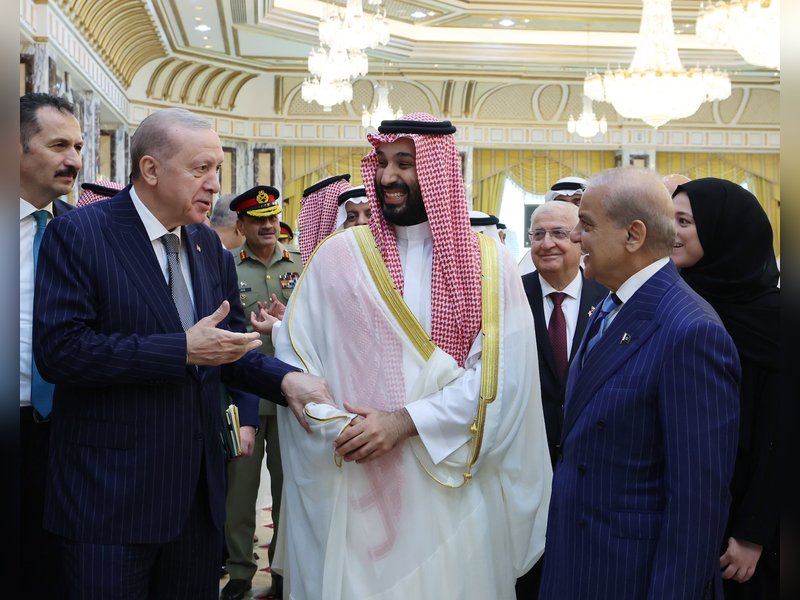
Sofia, Aug 11 (IANS) The Mecca Joint Defence Agreement involving Pakistan, Saudi Arabia and Turkey risks remaining largely rhetorical unless it clearly defines what constitutes aggression, identifies the circumstances that would trigger a military response, and outlines how the three countries would coordinate their forces, a report has stated.
The trilateral pact signed on August 7 in Saudi Arabia's Mecca does not constitute a conventional or well-structured military alliance. Instead, it appears to be a "backup plan", with the three middle powers preparing for a scenario in which they can no longer rely fully on the security guarantees of the major powers. Moreover, the agreement is framed in vague terms, with no clear obligation for any of the three countries to go to war if another member is attacked, a report in Bulgaria-based 'Modern Diplomacy' highlighted.
“The agreement states that an attack on one member is considered an attack on all three — language similar to Article 5 of NATO. The purpose of such a commitment is to deter an adversary from attacking in the first place, through the promise of a collective response. Applied to the Mecca pact, however, the picture looks very different, because the three countries face different security threats, different strategic interests, and different relationships with the major powers," the report mentioned.
"Simply declaring that ‘an attack on one is an attack on all’ does not, on its own, create a strong deterrent. Instead, it reads more like a political statement — one vague enough to let each country decide for itself how far it is willing to go if another member comes under attack," it added.
According to the report, Pakistan’s track record under its existing defence commitments raises doubts about how much credibility the new trilateral pact can command. While Islamabad deployed troops in Saudi Arabia during Iranian attacks, it stopped short of directly joining the conflict against Iran, even as Tehran repeatedly targeted Saudi territory.
“If an explicit bilateral mutual-defence commitment produced a defensive deployment but not direct military engagement, there is little reason to expect a looser trilateral agreement — one that now also has to account for Turkey’s separate strategic priorities — to produce anything firmer,” the report noted.
Amid the US-Iran war, the report said, Riyadh has become increasingly skeptical about the reliability of US security guarantees. Several developments have deepened those concerns, particularly Iranian missile strikes on Gulf oil infrastructure, which exposed the vulnerability of Saudi Arabia’s critical assets despite the protection offered under the US security umbrella.
“Riyadh has also signed a civil nuclear cooperation agreement with Washington that notably does not include the IAEA’s Additional Protocol, the mechanism that provides for the most rigorous international inspection of a country’s nuclear activities. Together, these developments suggest Riyadh is building its own backup options rather than relying solely on US security guarantees,” the report in 'Modern Diplomacy' mentioned.
--IANS
scor/as