
New Delhi, Sep 5 (IANS) The Common Research and Technology Development Hub on Affordable Healthcare at IIT Kharagpur has entered a sustainable phase, transitioning from grant support to a self‑sustaining national facility that will continue to develop and commercialise low‑cost medical technologies, an official statement said on Saturday.
The hub will meet operational costs through user fees, industry sponsorships and translational partnerships while continuing to provide infrastructure and technical support to MSMEs, start‑ups and innovators.
The facility will continue to provide state-of-the-art infrastructure, technical expertise, and technology development support to MSMEs, startups, innovators, and other stakeholders.
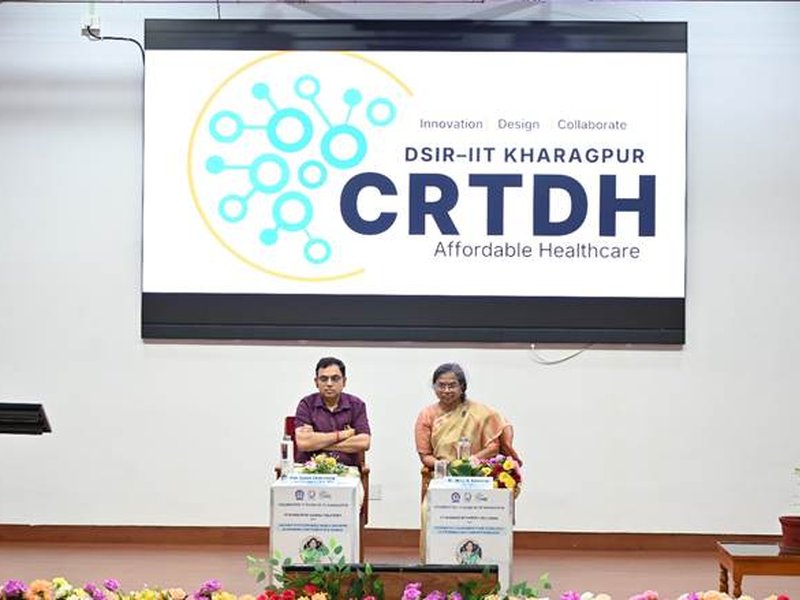
The Sustainable Phase of the DSIR‑CRTDH was inaugurated by Dr. N. Kalaiselvi, Secretary, Department of Scientific and Industrial Research and Director General (DSIR), Council of Scientific and Industrial Research, the statement from the Ministry of Science & Technology said.
"The transition of the CRTDH to a self-sustaining model marks an important milestone in strengthening industry–academia collaboration, technology translation, and innovation-led healthcare solutions, while ensuring the continued availability of shared research and technology development infrastructure," the statement noted.
CRTDH has facilitated over 20 technology transfers, many already commercialised, and has partnered with clinical and non-governmental organisations to establish rural health units to support the deployment of affordable healthcare technologies through rural health units.
Kalaiselvi emphasised the role of DSIR and the network of CRTDHs in enabling MSMEs, start-ups and individual innovators to strengthen indigenous capability in medical technology.
The continued functioning of a CRTDH beyond the period of DSIR support demonstrates the intended outcome of the programme to serve industry and innovators in a self-sustaining mode, Kalaiselvi said.
She emphasised that wider utilisation of these facilities would contribute to strengthening the country's indigenous technological capabilities and advancing self-reliance in medical device technologies.
Suman Chakraborty, Director, IIT Kharagpur highlighted the importance of frugal innovation in addressing the constraints faced in real-world healthcare delivery.
He said that designing technologies for use in settings without sophisticated infrastructure and by frontline health workers requires engineering solutions that are robust and accessible.
—IANS
aar/ag