
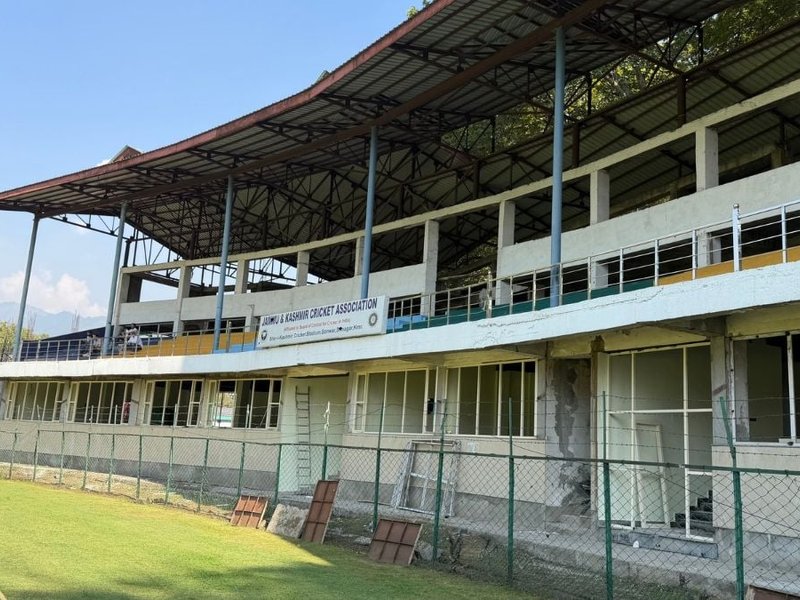

Srinagar, Sep 30 (IANS) It’s hard to ignore the sheer buzz around the picturesque Sher-i-Kashmir Stadium. Located in Srinagar’s Sonwar Bagh area, the ground is nestled in an environmentally rich area – by the side of the Jhelum River, tall chinar trees, serene hills and the Shankaracharya temple atop make for a picture-perfect view. Add to it the cool breeze that comes in brings a setting that makes cricket feel at home.
But when you look closer, barbed wire rings around the ground catch your eye, while sniffer dogs are doing a final check. Outside, fans jostle in line for passes, holding up a copy of their Aadhaar card, and nobody seems to mind. When the Irani Cup begins here, with Rishabh Pant's Rest of India facing Ranji Trophy champions Jammu and Kashmir, it will mark the start of a time Srinagar has waited for a very long period.
The last big-ticket fixture in the city was an ODI between India and Australia in 1986. The one before it, in 1983 against the West Indies, came just months after Kapil Dev's team epically won the ODI World Cup. Raju Raina, then a college student, was in the stands for the clash on October 13, 1983 and still remembers it clearly.
"Excitement was there as it was the first ODI between India and the West Indies after India were crowned the World Cup winners at the mecca of cricket – Lord’s in London. Upon reaching the stadium, the teams were doing their warm-up. Soon the match started, and India were put in to bat first.
“It was a full house & the atmosphere was good initially. It was the first time I had the opportunity to see our World Cup-winning cricket stars so up close. One of the friends of my elder brother-in-law got us tickets for 10 rupees, which translates to 1000 rupees for seeing modern-day international games in India."
"The conditions were comparable to the ones obtainable in England. The ball swung well, as October in Srinagar is pretty cold & fresh. Quite a picturesque cricket stadium, with the Jhelum River on one end & the Shankaracharya hill on the other. A slight breeze was running across the ground," he said in a free-wheeling chat with IANS.
After India were bowled out for 176 in 41.2 overs, twelve men came in to dig in the pitch at lunch break, but matters got settled before the West Indies reply started. At 108/0 in 22.4 overs, a dust storm came and forced the game to be abandoned, with the West Indies declared winners. Raju, who also saw a three-day match between North Zone and the visiting Australian team, which had the likes of Ashok Malhotra and Raman Lamba, still remembers it well.
"The match progressed well until India completed their innings. During lunchtime, suddenly a few people emerged from nowhere and dug up the pitch. But the management got the pitch rolled, and the West Indies innings started. Soon there was a dust storm due to which the match had to be abandoned and the West Indies won. A section of the crowd was restive, engaging in sloganeering etc.”
Though 12 men were arrested, they were acquitted in 2011. Ravinder Pandita, a former All India Radio and Doordarshan Kashmir commentator who now chairs the Save Sharda Temple Committee - Kashmir, clearly remembers the mood around the 1983 ODI in Srinagar
"Cricket had its own place in Kashmir, despite the craze for football. Even in cricket, the craze was particularly for Pakistani players because if you go to any college or hostel in those days, then you would find cricket players - not just footballers, cricket players.
"Before that 1983 ODI, Ranji Trophy matches were going on and, suppose Punjab would come to play or Haryana, they would boo them out. Support was for the J&K team, but J&K was always losing," he said to IANS from Teetwal village.
Pandita still remembers the tension before the match in October 1983. "Before this India-West Indies ODI, they dug the pitch at night. The West Indian players, I remember, were staying in Broadway Hotel. Many were opposing the hosting of this game, and in this way, the separatists tried to derail it by saying that they don't want to play it happen."
Such was the effect that an entertainment band assigned for the entertainment of the visitors couldn’t reach their hotel. “Then at the last moment, they called us from REC Srinagar. A few youths led by Sukumar Singh Manipuri, who played the guitar, were there, and my brother was playing the mouth organ, and then there would be Anuj Dayal; he would be on the congo.
“We played in the band and entertained the West Indies players because the main band couldn't come due to the mahaul created. So, it was only the filmi tunes which were played. I think for half an hour we entertained them, and that was the situation.
"The next day, they found the pitch was dug on the day of the match. Then again, during the lunch break, it was dug in, and then a storm came, and the game was over. So, players had to take cover because booing and throwing bottles were happening towards the Indian fielders.
"The West Indies were also worried about what would happen in those days. They were quite frightened about whether they were playing in India or not. They were not willing to play, but somehow, I think organisers convinced them to take on the field. So, Indians were always astonished by what was happening. The atmosphere was very bad. The stadium was filled, but it was not mainly for the interest of the game – it was full of people there to boo Indian cricketers.
"Then, next was 1986, India versus Australia ODI. That was captained by Allan Border, and two Kashmiri Pandits were working on the game - Dhruv Narayan Koul, an SBI employee at that time, was the scorer, and I was the commentator, though I didn’t do anything as I was observing JP Narayan in English and Indramohan Sahay in Hindi commentary. I interviewed Sunil Gavaskar at a houseboat in Dal Lake, and Allan Border was also there. So, that match went okay and was won by Australia."
Then the quiet came. As militancy spread and Kashmiri Pandits like Pandita and Raina were forced to leave Srinagar, paramilitary forces occupied the stadium complex for 18 years and used the dressing rooms as living quarters and stores. First-class cricket returned in 2009, but big games stayed rare. The love of the game never faded, though, and when the Legends League visited Srinagar in 2024, even a makeshift venue was packed.
Pandita went back to see the ground for himself two months ago. "The majestic Chinar trees are still standing, and I saw them while I was staying in Circuit House. But it's a very small stadium, right? Now we have exposure to bigger stadiums. I thought. 'What kind of a stadium is this?'
He believes cricket has won over the valley and its people, now that the likes of Parvez Rasool, Umran Malik, Rasikh Salam and Auqib Nabi are now in India and India ‘A’ set-ups. "Yes, definitely, because the way local tournaments are happening here, people have forgotten football now, while hockey is totally gone. I think Hockey will never pick up again. Football is not the same as it used to be before. So now it's all cricket. Whether it's Baramulla or Anantnag, cricket has become a big thing."
That devotion and love for cricket now has a team to match. Jammu and Kashmir won their first Ranji Trophy in February, after 67 years of trying, and Nabi’s ODI debut in Guwahati, though he leaked 84 runs, made everyone delighted in Srinagar. The stadium was in a race against time to have everything a top-class stadium needs for smooth functioning.
Workers raced against time to finish the work in the stands, scoreboard and commentary room, and the venue cleared inspection before everyone came in. When the gates open on Thursday, pass-holders will flood the stands to welcome their home side out onto the field as reigning Ranji Trophy champions, while hoping Paras Dogra and his team deliver a great performance to mark Srinagar's long-awaited return to top-flight cricket, hosting a memorable one before the harsh winter arrives.
--IANS
nr/bsk/