
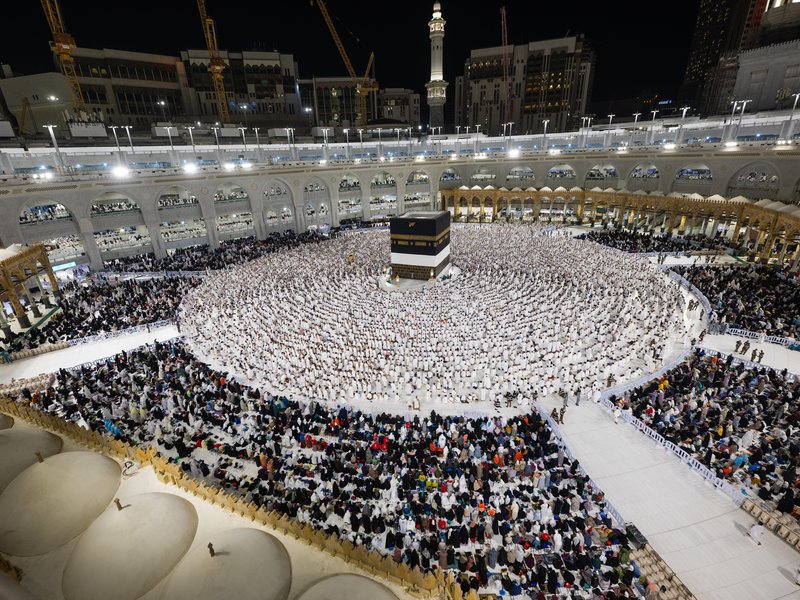
London, Jan 12 (IANS) The annual Hajj pilgrimage, one of the largest religious gatherings in the world, continues to test the faith of millions of Muslims and the administrative capacity of governments.
In India, the system of Hajj assistance has evolved into a model of inclusion and efficiency, ensuring equal access for pilgrims across diverse social and regional backgrounds.
Khaleej Times reported that from the moment an Indian pilgrim submits an application to the final rites at Arafat, Mina, and Muzdalifah, the Indian state plays a facilitative rather than intrusive role.
The emphasis is on service, not symbolism - providing safety, dignity, and equal opportunity without discrimination or privilege. According to Khaleej Times, the introduction of online applications, digital lotteries, and time-bound documentation has streamlined the process, reducing middlemen and discretion.
Whether a pilgrim comes from a metropolitan city or a remote district, the procedure remains uniform, with no fast tracks for the influential and no hidden barriers for the poor.
One of the most significant reforms, as highlighted by the newspaper, was the abolition of the Hajj subsidy in 2018.
While initially criticised, the move redirected funds toward education and welfare, while travel costs were rationalised through better negotiations with airlines and Saudi authorities. The result was a more transparent system where religious obligation was responsibly facilitated.
The newspaper also noted India’s inclusive approach to representation. Delegations include doctors, paramedics, sanitation workers, translators, and volunteers from across the country.
Medical missions provide free healthcare, particularly for elderly pilgrims, and Indian doctors have earned praise for their round-the-clock service in clinics across Mecca and Medina.
This is diplomacy expressed through service, not speeches. It is further reported that special attention has been given to women pilgrims. India’s decision to allow them to travel without a male guardian, in line with Saudi regulations, opened opportunities for widows, single women, and the elderly.
Inclusiveness is also reflected in language support, with training sessions, manuals, and helplines offered in multiple Indian languages to cater to diverse regions.
On the ground in Saudi Arabia, Indian officials coordinate accommodation, transport, food, and crowd management to ensure pilgrims are neither segregated nor disadvantaged.
The newspaper observed that India’s approach avoids religious exceptionalism, framing Hajj assistance within the broader constitutional promise of equality and freedom of religion.
For lakhs of Indian pilgrims, many of whom save for decades to undertake Hajj, this support is tangible - whether in the reassurance of a medical camp, the comfort of hearing one’s mother tongue abroad, or the confidence of consular help in times of distress.
India’s Hajj assistance framework stands as a quiet but powerful example of how a diverse democracy can honour devotion with dignity, it said.
The report also underlined that India’s facilitation of Hajj is part of a wider tradition of supporting major religious gatherings, from the Kumbh Mela to the Amarnath Yatra.
This parity strengthens national trust, showing that secular governance can embrace diversity without hierarchy.
For pilgrims, the journey is not only spiritual but also a lived testament to how democracy can deliver fairness in faith.
--IANS
sktr/dan