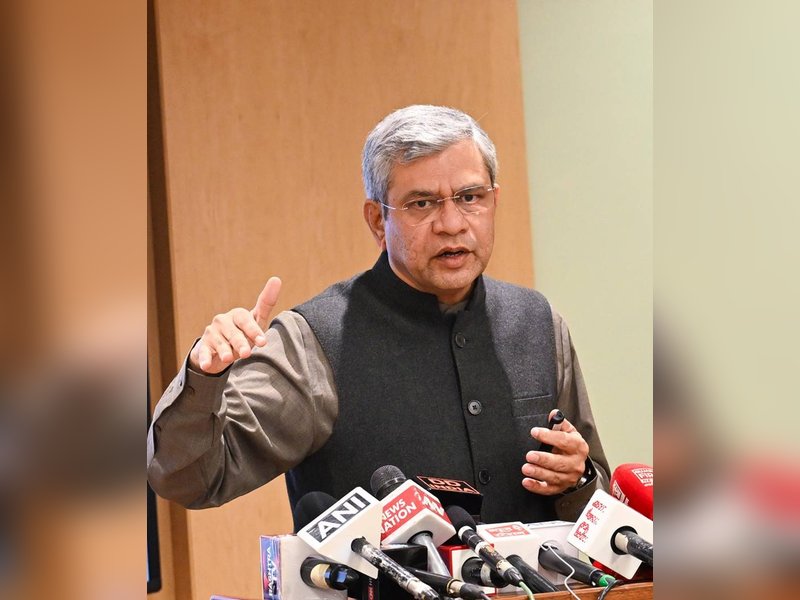
New Delhi, Feb 14 (IANS) Union Minister for Railways, Information and Broadcasting and Electronics & Information Technology, Ashwini Vaishnaw, on Saturday announced two new reforms approved by Indian Railways as part of its plan to carry out “52 reforms in 52 weeks” during 2026.
He said reforms are not one-time decisions but an ongoing process aimed at continuously improving the railway system.
The Minister said the results of sustained reforms are already visible, with Indian Railways emerging as the second largest cargo carrier in the world.
"New-generation trains and modern working practices are being adopted across the network," Vaishnaw mentioned.
Explaining the first reform, Vaishnaw said that from 2026 onwards, Indian Railways will introduce proper end-to-end cleaning of trains, especially long-distance services.
"Till now, deep cleaning was mostly limited to reserved coaches. For the first time in railway history, general coaches will also be fully included in the regular cleaning system," the minister added.
He said the earlier “Clean Train Station” model, where intensive cleaning happened only at select stations, is being replaced by a continuous cleaning system that will operate throughout the journey, from the train’s starting point to its destination.
"Toilets, garbage bins, coach interiors, water supply, and minor electrical or mechanical issues such as faulty lights will be addressed during the journey itself, giving passengers a much cleaner and more comfortable travel experience," he mentioned.
The Minister said this reform has been designed with the goal of completely improving the passenger travel environment. After discussions with Zonal Railways, four to five trains per zone -- mainly long-distance and high-footfall trains -- have been selected for rollout over the next six months.
In the first phase, 80 trains across different zones have already been identified. Over the next three years, the system will be expanded to cover all trains. The selection has been done by railway managers based on ground-level inputs and operational needs.
"Professional, technology-enabled teams will be hired under clear Service Level Agreements that define how often cleaning must be done," the Union Minister stated.
"Cleaning frequency will be higher during peak hours and lower during non-peak periods. Continuous toilet cleaning, garbage removal, interior cleaning, linen handling and related services will be ensured," Vaishnaw said.
He added that linen distribution, collection and cleaning, which were earlier handled by different agencies, will now be combined and given to a single agency.
--IANS
pk