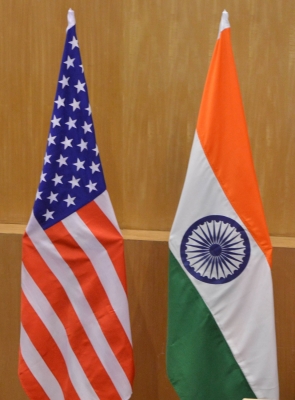
Washington, July 2 (IANS) India will mount a coordinated challenge next week to a proposed US tariff on its exports, with government officials and leading industry bodies arguing that Washington's findings on forced labour are legally flawed, unsupported by evidence and could disrupt supply chains linking the world's largest and fifth-largest economies.
The challenge will be presented before the Office of the US Trade Representative's (USTR) Section 301 Committee on July 8.
Poornima Shenoy of the Federation of Indian Chambers of Commerce and Industry (FICCI) and Shuchita Sonalika of the Confederation of Indian Industry (CII) are scheduled to testify during Panel 8.
They will be followed in Panel 9 by Dr Brij Mohan of the Ministry of Commerce and Industry and Shubham Arora of the Agricultural and Processed Food Products Export Development Authority (APEDA). Vinnie Mehta, Director General of the Automotive Component Manufacturers Association (ACMA), will testify on July 9.
The hearings follow USTR's proposal to impose an additional 12.5 per cent duty on imports from India under a Section 301 investigation into whether countries prohibit and effectively enforce restrictions on imports of goods produced with forced labour. The proposal is open for public comments before a final decision is taken.
India's Ministry of Commerce and Industry has rejected the USTR's conclusions.
In its submission, the ministry says India has a "robust domestic legal regime reflecting a structured and progressive approach combining statutory prohibitions, institutional mechanisms, and ongoing policy measures aimed at reducing vulnerability to forced labour."
It also argues there is "inadequate and insufficient evidence" that India's import regime burdens or restricts US commerce, a requirement for action under Section 301.
The Confederation of Indian Industry has made a detailed legal and economic case against the proposed action.
CII says India's policy framework does not qualify as "unreasonable" or "discriminatory" under Section 301 of the US Trade Act. It says India's legal safeguards are anchored in Article 23 of the Constitution and reinforced by the Bonded Labour System (Abolition) Act, the Child Labour (Prohibition and Regulation) Amendment Act and the four Labour Codes adopted between 2019 and 2020.
The industry body also points to mandatory Environmental, Social and Governance reporting and Business Responsibility and Sustainability Reporting requirements for listed companies. It notes that India has ratified key International Labour Organisation conventions against forced labour and child labour.
CII disputes examples cited in the USTR report.
It says India imported no rice from Myanmar and no tobacco from Malawi during the 2021-2025 review period. It argues these examples do not establish any direct link between India's imports and forced labour. CII also notes that India imported US$1.537 billion worth of American cotton between 2021 and 2025, almost twice its imports from China. It says this demonstrates there is "no material evidence" that India's policies unfairly burden US commerce.
CII further argues that sectors such as forgings, foundries and agricultural machinery are capital-intensive, skill-dependent and globally integrated. It says the use of forced labour is fundamentally incompatible with these industries. It also says Indian exporters supplying American manufacturers already operate under buyer-directed compliance systems and voluntary certification programmes.
"The proposed 12.5 per cent additional duty would raise costs for US manufacturers dependent on Indian inputs without addressing the stated policy objective," CII says. It urges USTR to pursue "compliance-based cooperation through the established India-US Trade Policy Forum as a more effective and proportionate alternative to punitive tariffs."
FICCI has also opposed the proposal.
The industry body says Indian export supply chains serving the US market already operate within "well-established compliance frameworks" built around traceability, supplier due diligence, independent audits and responsible sourcing. It argues that broad-based tariffs would increase costs for American businesses and consumers while disrupting resilient supply chains that have expanded significantly in recent years.
APEDA plans to defend India's agricultural exports before the committee.
Its submission says India's rice sector "does not engage forced labour nor does it import inputs made with or using forced labour." It argues that Indian rice exports comply with recognised standards and should not be subject to the proposed additional duties.
ACMA has focused on the impact on manufacturing.
It says India's automotive component industry is organised, technology-driven and governed by established labour compliance frameworks. The association has asked USTR to exempt automotive components. It argues that additional duties would disrupt integrated supply chains, increase costs for US manufacturers and create sourcing uncertainty for the American automotive industry.
The Section 301 investigations cover 60 economies and focus on whether countries have imposed and effectively enforced legal prohibitions on imports produced wholly or partly with forced labour.
USTR argues that the absence of such measures creates unfair competition for American businesses. India maintains that its constitutional protections, labour laws, regulatory framework and corporate compliance systems already provide robust safeguards against forced labour. It argues the proposed tariff is therefore unwarranted and could undermine the expanding India-US trade partnership.
--IANS
lkj/sd/