
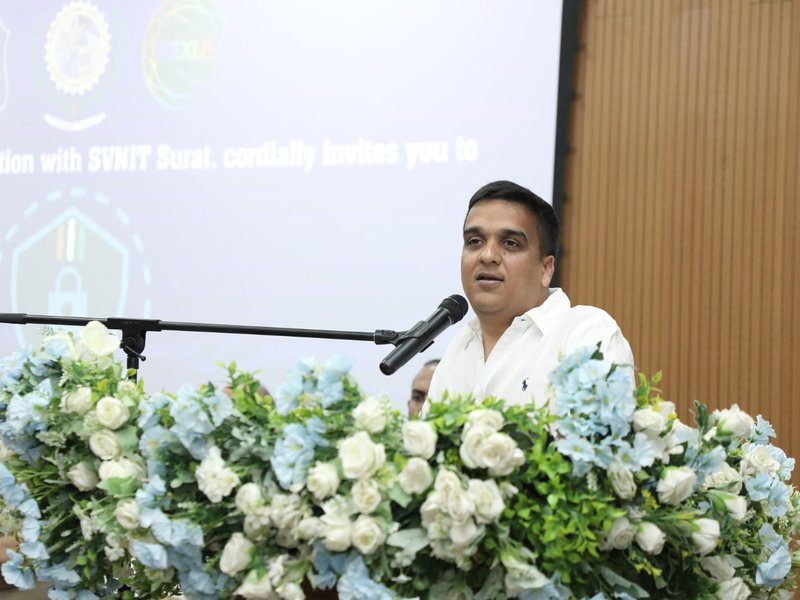
Surat, Oct 10 (IANS) The Gujarat government aims to connect all CCTV cameras across the state to a single dashboard and integrate technology developed by young innovators into police procedures, including FIR registration and cybercrime resolution, Deputy Chief Minister Harsh Sanghavi said on Saturday.
Addressing the grand finale of the E-Rakshak Hackathon at Sardar Vallabhbhai National Institute of Technology (SVNIT) in Surat, Sanghavi said the state government wanted to encourage software-based solutions that could improve policing and reduce dependence on frequently changing hardware.
He reviewed cybersecurity prototypes developed by 31 teams representing colleges affiliated with more than 13 universities across six states.
The grand finale brought together 150 students, selected from 458 registrations received from across the country.
"Changes in hardware and camera models introduced by major companies could increase government expenditure, making sustainable software solutions an important priority," he said.
He encouraged students to use their technical expertise to address practical challenges faced by citizens and the police. He also highlighted the potential of artificial intelligence integrated with CCTV cameras to improve traffic management.
"Even a 15-second reduction in waiting time at traffic signals could save millions of people valuable time and fuel," he added.
The Deputy Chief Minister urged young people to look beyond social media discussions and familiarise themselves with government schemes designed to support entrepreneurship.
He referred to Gujarat's industrial and startup policies, initiatives for micro, small and medium enterprises (MSMEs), and schemes in the science and technology sector.
"Eligible entrepreneurs could receive assistance for office rent, marketing, operational expenses, salaries and cloud subscriptions, besides support available through the Startup India Seed Fund Scheme," he noted.
He also highlighted provisions for women entrepreneurs. Assuring the participants of government support, Sanghavi said the state is prepared to act as a risk partner for startups and share the risks involved in turning innovative ideas into practical solutions.
Sanghavi also commended the Surat Cyber Crime Team for dismantling cybercrime rackets operating at national and international levels.
"The government wanted to work with young innovators to develop technology that could help prevent crime and improve the efficiency of police operations," he said.
Surat Police Commissioner Wabang Jamir said the hackathon is jointly organised by Surat City Police and SVNIT's NEXUS unit to encourage college students to develop technological solutions for cybersecurity, digital safety and cybercrime prevention.
Deputy Commissioner of Police (Cyber Crime) Bishakha Jain said organisers had identified nine to 10 problem statements through surveys conducted at police stations.
"These focused on everyday difficulties faced by citizens and operational challenges encountered by police personnel," she said.
A total of 458 students from colleges across the country registered for the hackathon, with 150 students representing 31 teams reaching the grand finale in Surat.
The initiative aims to promote more efficient policing through technology and encourage students to develop solutions that can be applied to real-world challenges.
The event brought together student innovators, police officials and academic institutions to explore how emerging technologies could strengthen cybersecurity and improve public services.
-- IANS
mys/brt