
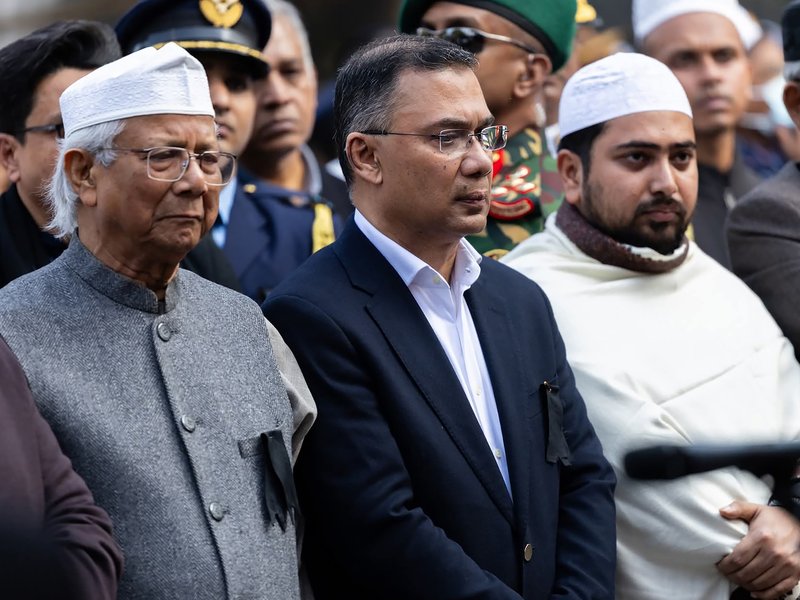
Ottawa, Jan 24 (IANS) Bangladesh’s interim government, led by Muhammad Yunus, which is linked to the so-called "reformist and technocratic" figures, appears either incapable or unwilling to control the growing unrest across the country. Attacks on Indian diplomatic facilities in December last year, including the temporary closure of an Indian consular presence in Chittagong district, underscored the gravity of the situation, a report said on Saturday.
According to a report in online magazine ‘Open Canada’, whether Bangladesh can uphold its secular constitutional principles amid the growing influence of religious political forces is an open question. It added that whether the February 12 elections in the South Asian nation will proceed as planned or be postponed under the guise of instability remains uncertain, reflecting a trend witnessed in other fragile democracies
“Bangladesh National elections are scheduled for February 2026, which will serve as a critical test of Bangladesh’s democratic recovery. The exclusion of the Awami League from participation has already cast doubt on the inclusiveness of the process. The Bangladesh Nationalist Party is expected to play a central role, while Jamaat-e-Islami — previously banned under Hasina’s government for links to extremist ideology — has re-emerged as a competitive political force, particularly in university politics,” the report detailed.
“Bangladesh’s current political turbulence cannot be understood without revisiting the historical foundations of the state itself. The roots of Bangladesh’s independence lie not only in economic neglect or political marginalisation, but also in a deeper struggle over identity, language, and democratic representation,” it mentioned.
The report stressed that Bangladesh’s experience demonstrated that while economic development can continue alongside weakened democratic institutions for a period, such arrangements are inherently fragile. Development without accountability, it said, leads to political upheaval rather than sustained stability.
Heightening these concerns is the ban on the Awami League’s participation in the upcoming elections.
“Many party officials and supporters have reportedly been detained in recent months, in some cases without formal charges or timely access to judicial review, raising broader questions about due process and political pluralism. The interim authorities have also imposed restrictions on Awami League-affiliated student group ‘Bangladesh Chhatra League' (BCL), move that critics argue risks narrowing the democratic space rather than stabilising it,” the report noted
Since Hasina’s ouster in 2024, it said, Bangladesh has entered a volatile transitional phase marked by political violence, attacks on minorities, and growing anti-India sentiment, raising concerns across the region.
“Particularly alarming are narratives advocating territorial revisionism, including calls for a so-called ‘Greater Bangladesh,’ which envision the annexation of India’s northeastern states. Historically, such rhetoric has served as a precursor to regional confrontation rather than peaceful reform,” the report emphasised.
--IANS
scor/as