

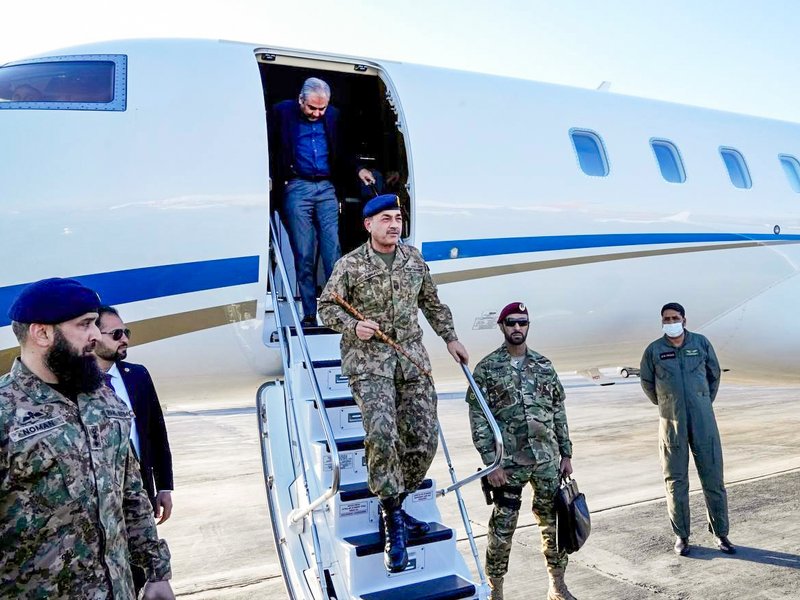
Washington, Sep 5 (IANS) Pakistani Army chief Asim Munir is presiding over a military takeover without a conventional military coup, with the country witnessing the quiet conversion of military influence into permanent constitutional and institutional power, a report has stated.
Through a series of constitutional amendments, new courts and sweeping legal changes over the past two years, Pakistan’s military has entrenched itself in the state’s institutional framework, extending its reach beyond the armed forces into the judiciary, economy and political space, a report in online magazine ‘American Thinker' detailed.
“The Defence Forces of Pakistan Act, 2026, passed August 20 amid an opposition walkout, is the clearest step yet. It gives the Chief of Defense Forces (CDF) full operational command over Pakistan’s armed forces — organisation, administration, readiness, joint operations, and personnel matters. Because Munir holds the CDF post while remaining Chief of Army Staff, the law effectively puts all three services under one office,” the report detailed.
“Munir became Army Chief in November 2022, on a three-year tenure. In November 2024, parliament extended that to five years. On May 20, 2025, he was made a five-star Field Marshal. But the constitutional changes that followed mattered more than the rank itself,” it added.
According to the report, Pakistan’s 27th Amendment, passed in November 2025, created the CDF post and stipulated that the army chief would hold it concurrently, meaning he no longer simply headed one of three coordinated services but stood at the top of the entire command structure.
British think tank Chatham House described the powers as “unprecedented”, citing the CDF’s seniority over the naval and air chiefs, lifetime immunity, and a higher bar for removal, it noted.
Highlighting the military’s growing role in Pakistan’s economy, the Special Investment Facilitation Council, created in 2023, has the Army Chief on its Apex Committee and a serving officer as National Coordinator, to determine which investments are prioritised.
“Munir himself now meets foreign investors and Gulf leaders directly. Yet overall investment has weakened: State Bank data shows foreign direct investment fell 34 per cent in FY2025–26, to $1.637 billion,” American Thinker mentioned.
The report also noted a shrinking civic space in Pakistan. It cited a US-based advocacy group, Human Rights Watch, which documented a sharp escalation in repression in 2025, marked by arbitrary detentions, curbs on the media, and communication blackouts.
“A joint appeal led by Amnesty International in August 2026 documented restrictions on journalists and lawyers, and prolonged internet shutdowns in Pakistan-Occupied Kashmir,” it added.
Stressing that the crackdown by Pakistani authorities has extended abroad as well, the report cited US-based think tank Freedom House, which warned in March 2026 of growing transnational repression, including life sentences handed down in absentia to seven exiled journalists and dissidents.
Additionally, international press freedom group Reporters Without Borders documented “four such sentences, alongside passport cancellations and frozen bank accounts, explicitly linking the deteriorating media environment to Munir’s expanded powers.”
“Taken together, these developments show that Pakistan’s military is now deciding how much dissent citizens are allowed, how justice is dispensed, and how the economy is run,” the report mentioned.
--IANS
scor/as