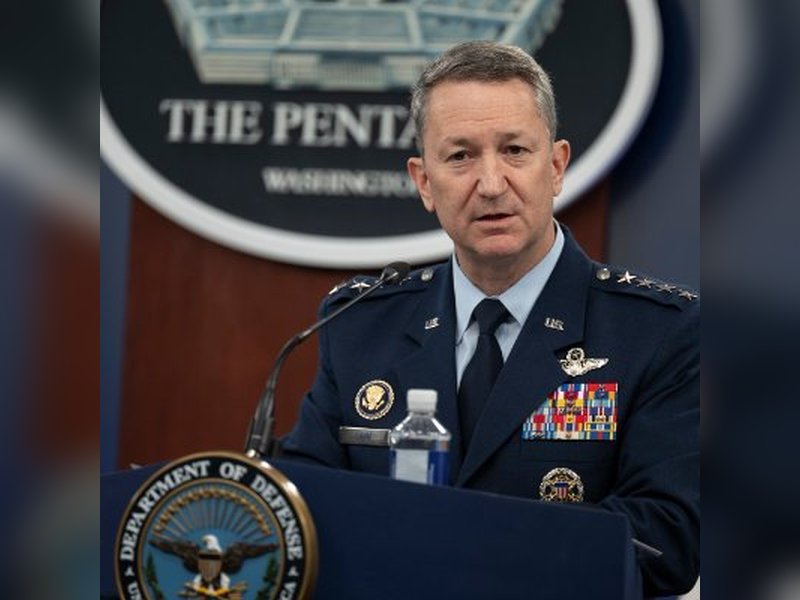
Washington, March 2 (IANS) The United States on Monday disclosed the scale of Operation Epic Fury, describing a coordinated air, naval, cyber, and space campaign that struck more than 1,000 targets across Iran within the first 24 hours and involved thousands of personnel, carrier strike groups, and long-range bombers operating across continents.
Chairman of the Joint Chiefs of Staff Air Force General Dan Caine said the campaign marked “the culmination of months and in some cases years of deliberate planning and refinement against this particular target set.”
Addressing a joint Pentagon news conference with Secretary of War, Pete Hegseth, the Air Force General said that “more than 100 aircraft launched from land, sea, fighters, tankers, airborne early warning, electronic attack, bombers from the states, and unmanned platforms, forming a single, synchronised wave.”
U.S. Central Command began the operation at 0115 Eastern Standard Time on February 28, following presidential authorisation. Caine described the opening phase as “a massive, overwhelming attack and across all domains of warfare, striking more than 1,000 targets in the first 24 hours.”
Caine, in his remarks and responses to questions, provided details on the scale of the force posture built up in advance of the strike. Over the previous 30 days, he said, the Joint Force “began to systematically reposition assets and personnel across the region” to reinforce deterrence and provide “credible options should action be required.”
That deployment included “thousands of service members from all branches, hundreds of advanced fourth and fifth generation fighters, dozens of refuelling tankers, the Lincoln and Ford carrier strike group, and their embarked air wings, sustained flow of munitions, fuel, supplies.”
Caine emphasized the integration of reserve and National Guard forces, citing the Wisconsin Army National Guard operating in Kuwait and Iraq and the Vermont Air National Guard’s 158th Fighter Wing, which redirected F-35As across the Atlantic to support the mission.
He also underscored the logistical backbone behind the campaign. “Our leaders from World War II were right when they said professionals do logistics,” he said.
The operation combined kinetic strikes with cyber and space operations. “The first movers were U.S. Cybercom and U.S. Spacecom, layering non-kinetic effects, disrupting and degrading and blinding Iran's ability to see, communicate, and respond,” Caine said.
American B-2 bombers flew a 37-hour round-trip sortie from the continental United States, dropping “precision, penetrating munitions” on underground facilities. Over roughly 57 hours, the Joint Force has “launched hundreds of missions from land and sea and delivered tens of thousands of pieces of ordnance,” he said.
Defensive systems have remained active throughout the campaign. U.S. Patriot and THAAD batteries, along with ballistic missile defence-capable Navy destroyers, “have intercepted hundreds of ballistic missiles targeting U.S. forces, our partners, and regional stability.”
Caine noted that allied air defence batteries in Qatar, the UAE, Kuwait, Jordan, and Saudi Arabia “joined the fight, proof positive that years of training, trust, and hard-earned integration pay off.”
“This work is just beginning and will continue,” he said.
Operation Epic Fury represents one of the largest integrated U.S. air and naval campaigns in the Middle East in recent years, combining conventional strikes with cyber and space operations in what officials describe as a fully synchronised joint-force effort.
--IANS
lkj/dan