
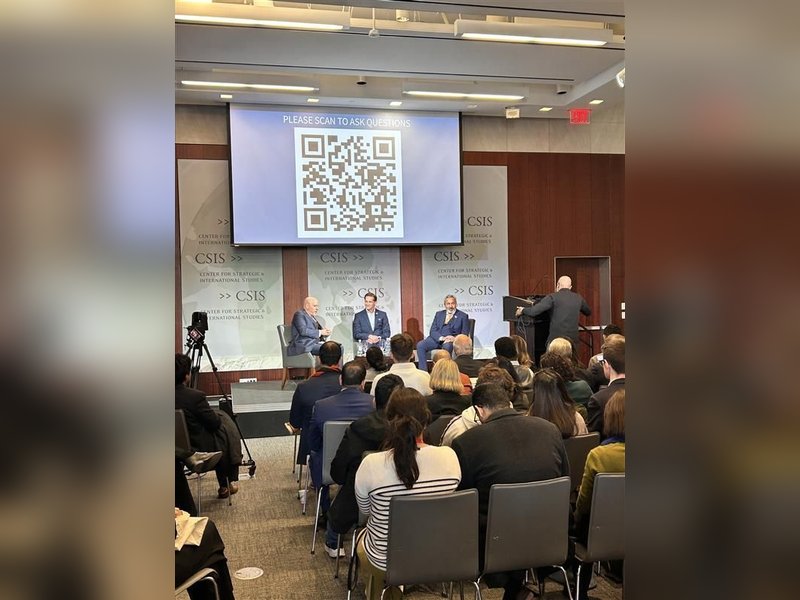
Washington, Jan 13 (IANS) Influential American lawmakers identified China as the principal strategic adversary of the United States and positioned India as the democratic counterweight critical to maintaining global balance and Indo-Pacific stability.
Addressing a CSIS forum, Representative Ami Bera said there is no ambiguity in Washington’s assessment of Beijing. “We know clearly who our adversary is in Beijing,” he said.
Bera said the competition with China is shaping US foreign policy across security, technology, and economics. “That’s going to be the leading competition in the world,” he said, adding that new global frameworks would be built around “like values, democracy, free markets, entrepreneurship.”
Representative Rich McCormick warned that mishandling ties with India could have severe consequences in the context of China’s rise. “If they start joining up with Russia and China, that will put everything out of balance for us,” he said.
McCormick said the alignment of India and the United States could fundamentally shape the century ahead. “If you unite… we could literally usher in a new generation of peace that could last 100 years if we do this right,” he said.
Both lawmakers contrasted China’s governance model with India’s. Bera described China as pursuing a different path. “China is a very different country with a different model,” he said, adding, “We don’t have to guess what Xi Jinping wants to do. He tells us.”
McCormick said China’s economic ascent had been marked by unfair practices. “They’ve been cheating their way to the top through the World Trade Organization,” he said, warning against allowing Beijing to set global standards.
Technology emerged as a central theme in the competition. McCormick cautioned against restricting India’s access to advanced US technology. “If we start limiting access to our products, that’s going to be bad for us as a country,” he said, arguing that exclusion would push partners toward Chinese alternatives.
Bera highlighted the importance of the Quad grouping involving the United States, India, Japan, and Australia. “The reason I know the Quad’s so important is because Beijing hates it,” he said.
The lawmakers also underscored India’s growing role in regional security. Bera said India is critical to maintaining “maritime security, freedom of navigation” in the Indian Ocean, warning against repeating mistakes made elsewhere in the Indo-Pacific.
McCormick said India’s democratic diversity gives it an edge over China’s centralized system. “United States and India have to think similar in the way that we approach our population,” he said, contrasting that with China’s “monolithic” approach.
--IANS
lkj/rs