
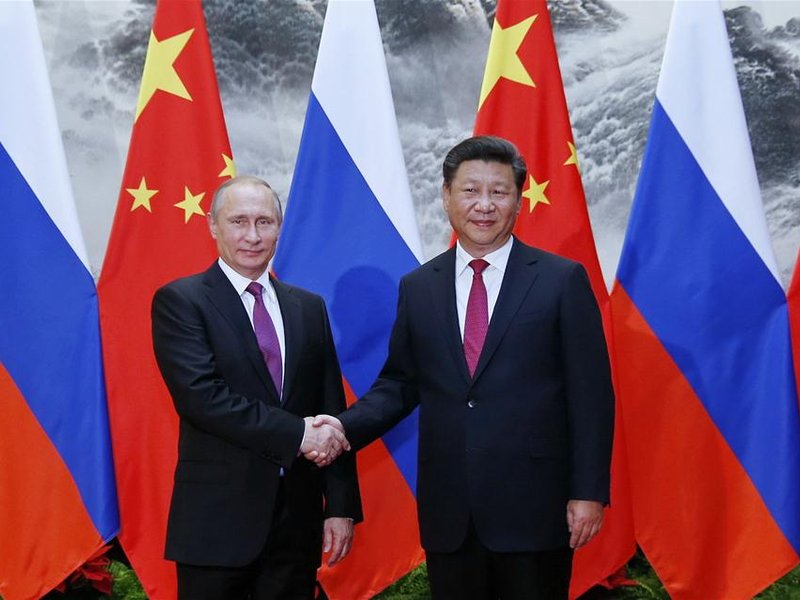
Washington, March 26 (IANS) The United States is now confronting two nuclear peer adversaries -- China and Russia -- in a rapidly shifting global security landscape, Undersecretary for Arms Control and International Security Thomas DiNanno told lawmakers during a high-stakes congressional hearing.
DiNanno said the evolving threat environment marks a historic shift, with Washington facing simultaneous nuclear challenges from both Beijing and Moscow, as well as rising risks from smaller nuclear states.
He emphasised that traditional arms control frameworks are no longer sufficient to address the scale and complexity of current geopolitical and technological challenges.
“As a nominee… I committed to seeking verifiable and enforceable arms control agreements that enhance America’s national security,” DiNanno said, adding that his office is focused on modernising outdated mechanisms.
The undersecretary argued that existing treaties had failed to reflect present-day realities, particularly the expansion of nuclear capabilities by US adversaries.
“New START… only constrained the United States while allowing Russia to build and maintain a vast theatre-ranged nuclear arsenal,” he said, defending the administration’s decision to move beyond the expired agreement.
DiNanno said the administration is now pursuing updated frameworks aligned with President Donald Trump’s vision for new agreements that are enforceable and adaptable to emerging threats.
“The President… called for a new treaty,” he said, noting that future arrangements must account for technological change and broader strategic competition.
Outlining the scope of his office, DiNanno said the State Department’s expanded “T family” integrates key security functions, including arms control, nonproliferation, counterterrorism, and political-military affairs, under a unified structure.
“The reorganisation consolidated the department’s international security functions,” he said, adding that the new structure improves coordination across export controls, sanctions enforcement and treaty verification.
He highlighted that his team oversees a broad portfolio ranging from preventing the proliferation of weapons of mass destruction to managing arms sales and coordinating international security partnerships.
“Our team works on critical national security matters… from preventing the proliferation of weapons of mass destruction to countering terrorism,” DiNanno said.
“At the State Department, our goal is diplomacy… managing those alliances,” he said, noting the importance of information sharing to counter next-generation threats.
The remarks come at a time when global arms control frameworks are under increasing strain. The expiration of the New START treaty has removed key limits on US and Russian strategic arsenals, raising concerns about a renewed arms race.
At the same time, China’s expanding nuclear programme -- outside any binding arms reduction framework -- has complicated efforts to establish new multilateral agreements, signalling a shift toward a more fragmented and uncertain global nuclear order.
--IANS
lkj/sd/