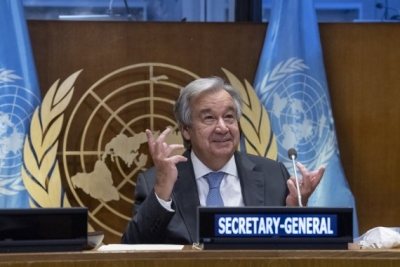
United Nations, June 29 (IANS) Secretary-General Antonio Guterres sounded the alarm on Monday against emerging technologies "super-charging" terrorism and said better cooperation among countries can "close critical gaps".
He said that in South Asia, "affiliates of Al-Qaida and Da'esh [Islamic State terror outfit] and other terrorist groups persist", as also in Africa and the Middle East, in threatening nations and people.
"Violent extremist narratives, including those based on xenophobia, racism, and other forms of intolerance, or in the name of religion or belief, pose deadly domestic threats in many nations," he said.
Issuing his warning about the growing threat, he said terrorists have grown adept at exploiting emerging technologies, including artificial intelligence, digital platforms, and unmanned weapons.
"These tools have supercharged their ability to recruit, finance, and plan attacks," he said.
But he also noted that technology offers powerful tools to detect threats early, stop the flow of illicit assets, and understand pathways to terrorist radicalisation.
He reminded the nations gathered for the Fourth United Nations High-level Conference on Counter-Terrorism that they had "made a commitment to harness digital tools for the public good" when they adopted the Pact for the Future and the Global Digital Compact in 2024 to enable the UN to address emerging challenges.
Guterres said that broader dangers facing the world are creating an environment conducive for terrorists to spread their tentacles, and these have to be dealt with, beyond conventional direct tactics to tackle terrorism.
"We meet at a moment of acute instability," he said. "Conflicts are triggering energy shocks, inflation and hunger across the globe. Temperatures are rising. Millions are displaced. And millions more face growing economic hardship."
"These conditions -- of want, of fragility, of mistrust -- are ideal circumstances for terror to thrive," he said.
But he emphasised that these wrongs do not justify terrorism and nothing can.
"We must address the conditions and grievances that allow terrorism to take root," he said.
The Acting Under-Secretary-General for Counter Terrorism, Alexandre Zouev, said the terrorist groups leverage instability, governance gaps, socioeconomic inequalities, and new and emerging technologies to expand their reach, recruit, and mobilise resources.
"The primary responsibility for preventing and combating terrorism falls on member states," he said.
At the same time, there is ample experience and valuable specialised knowledge beyond simply governments for fighting terrorism, among "a broad diversity of actors in counter terrorism, including the United Nations system, regional organizations, civil society, the victims of terrorism, women, young people and academia", he said.
The high-level conference is held as part of the Counter-Terrorism Week observed at the UN.
Its theme is "A Future Free from Terrorism: Consolidating the Global Commitment to Multi-Stakeholder Approaches to Counter Terrorism, notably through Member States' Leadership and Action".
--IANS
al/dan