

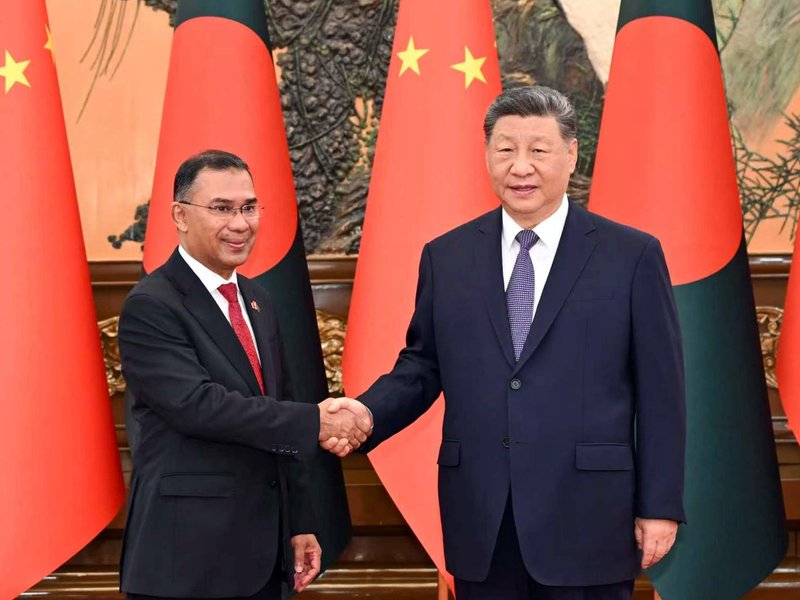
Dhaka, July 13 (IANS) Security concerns remain perhaps the biggest obstacle for the implementation of the proposed China-Myanmar-Bangladesh Economic Corridor (CMBC), despite renewed momentum for the project following Bangladesh Prime Minister Tarique Rahman's visit to China in June.
The corridor was among the key issues discussed during the visit. It envisages a road and rail network linking Kunming in China's Yunnan province with Bangladesh's ports via Myanmar, a report has stated.
Highlighting the security implications, a report in Bangladesh's newspaper 'Daily Sun' said, “The proposed route would pass through Myanmar's conflict-ridden Rakhine State, where fighting has continued since the military takeover in 2021. The Arakan Army now controls or influences much of the territory through which the corridor would run, creating serious uncertainty for long-term infrastructure projects.”
“The ongoing Rohingya crisis adds another layer of complexity. Bangladesh continues to host around 1.2 million Rohingyas, and analysts argue that any regional connectivity initiative should not undermine efforts to ensure their safe, voluntary and dignified repatriation,” it added.
Citing experts, the report warned that infrastructure passing through conflict zones could inadvertently strengthen armed groups by creating new sources of revenue or influence, underscoring the need for comprehensive security assessments before any commitments are made.
The initiative revives the Bangladesh-China-India-Myanmar (BCIM) Economic Corridor, originally proposed in 1999. However, India later exited the project due to concerns over China's Belt and Road Initiative (BRI) and Beijing's increasing regional influence, effectively leaving the corridor without New Delhi's participation.
Beyond security, the report said that the corridor has significant geopolitical implications. India remains concerned about projects that could increase China's presence near its sensitive northeastern region and the Siliguri Corridor, while the United States has encouraged Bangladesh to preserve its strategic balance amid deepening economic ties between Dhaka and Washington.
According to the report, the financial consequences of the proposed corridor also require close scrutiny. Large infrastructure projects entail substantial investment, sustained maintenance and commercially viable operations. It cited economists who argued that any major investment should be assessed against competing national priorities, including port modernisation, export infrastructure, climate resilience, healthcare, education and industrial development.
Analysts reckoned that Bangladesh should evaluate the proposal solely through the lens of its national interests rather than geopolitical competition.
“Lessons from projects such as the China-Laos Railway, the China-Pakistan Economic Corridor and Sri Lanka's Hambantota Port show that infrastructure alone cannot guarantee economic success. Transparent financing, careful feasibility studies, strong institutions and a competitive domestic economy are equally important,” the report noted.
--IANS
scor/as