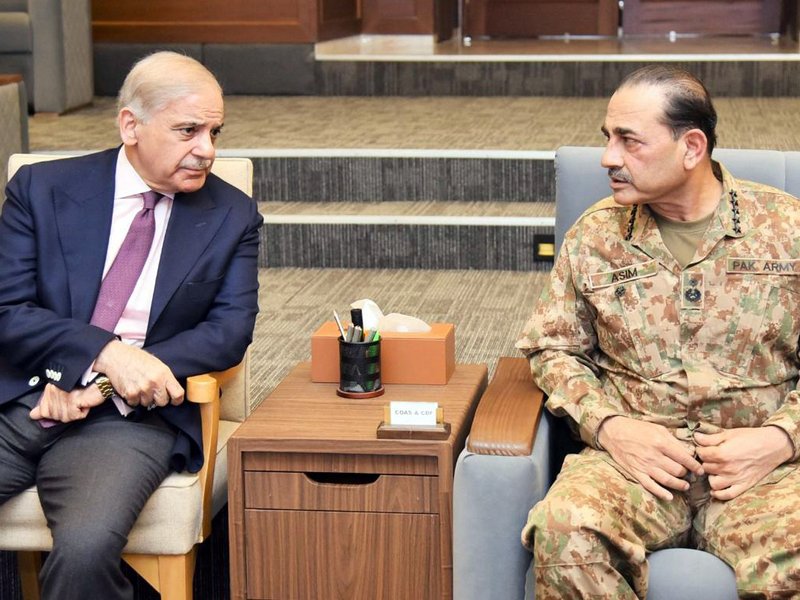
Islamabad, Sep 24 (IANS) Sealing Islamabad and Rawalpindi from the rest of the country will not help the Pakistan government in managing crisis, as the mismanagement of economic, political and governance issues has exposed the Prime Minister Shehbaz Sharif-led government's position, a report has detailed.
The Pakistan government continues to increase prices of fuel every day, and the protest march of Jamaat-e-Islami (JI) against the petroleum levy and the increase in prices of petroleum products has not been able to impose any pressure on the Pakistani authorities, a report in 'The Friday Times' mentioned.
"Likewise, those wielding power are overreacting to PTI’s protest march on Islamabad for the release of founding Chairman Imran Khan and the surge in prices of essential commodities but is not reluctant to use excessive force by ordering large-scale arrests and deployment of hundreds of containers in Rawalpindi and Islamabad to prevent PTI long march and protest," Moonis Ahmar, Professor of International Relations and former Dean Faculty of Social Sciences at the University of Karachi, wrote in the leading Pakistani daily.
He mentioned that even though the price of crude oil reached below 100 dollars a barrel, the government of Pakistan did not reduce the price of petrol and diesel. Pakistan is the only nation in the world which reviews prices of oil and diesel on a daily basis, as authorities neither feel accountable nor concerned about the impact of increases in the prices of petroleum products on the people of the country.
Ahmar stated that Pakistan government is interested in extracting more and more money from people to maintain its lavish lifestyle and pay interest on foreign and domestic loans. Apart from the hike in prices of petroleum products, Pakistan has also witnessed a rise in electricity tariffs, the price of gas, vegetables, fruits, meat, milk, flour and cooking oil.
The report mentioned that as the 26th and 27th amendments allow Pakistani authorities to crush any popular uprising, the military establishment and their civilian partners believe that voices of dissent, which are getting an impetus due to economic challenges. With the judiciary tamed, media neutralised, civil society weakened, the coalition partners also do not have the wisdom to salvage democracy. However, Pakistani authorities will be able to use force only until the leadership in civil society, lawyers, media and the youths of Pakistan decide to take the risk of starting a fierce movement against the status quo, Ahmar wrote in The Friday Times.
"Sealing Islamabad and Rawalpindi from rest of the country will not help manage crisis which is of a critical nature. It is not only economic cost of sealing the capital which matters but the image of the country will also go down the drain. If there is some brainstorming going on in circles representing military establishment to avoid a civil war like situation it would mean prevalence of sanity and strategic prudence. Finally, the coalition government because of its mismanagement of economic, political and governance issues has thoroughly exposed its position," Ahmar emphasised.
Ahead of Pakistan Tehreek-e-Insaf (PTI) planned protest on September 27, the local authorities have banned all kinds of gatherings and processions in Islamabad for two months. According to the order, all kinds of gatherings of five or more persons, processions/rallies and demonstrations at any public place in Islamabad, including the Red Zone, have been prohibited, Pakistan's 'Dawn' newspaper reported.
The Punjab government has also imposed a 13-day ban on public gatherings across the province, closing roads and businesses in and around Attock and Rawalpindi and deploying Rangers paramilitary forces in four districts of the province.
--IANS
akl/as