
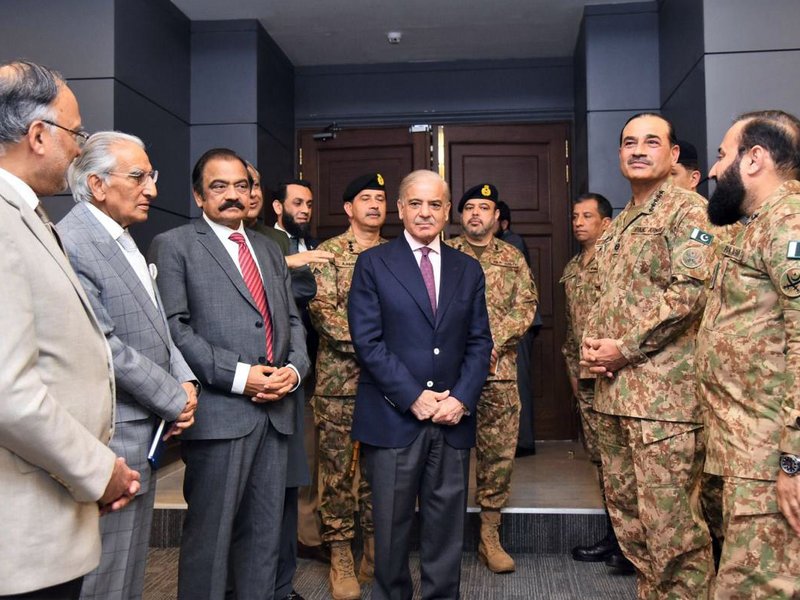
Islamabad, March 27 (IANS) Pakistani military establishment, under the leadership of Asim Munir, has abandoned the facade of economic recovery and opted for a "strategic psychosis". As ordinary Pakistani citizens struggle with record-breaking inflation and a collapsing power grid, the 'Men in Olive Green' are diverting the nation's dwindling resources towards Intercontinental Ballistic Missile (ICBM) development and reconstruction of their proxy terror networks, a recent report has highlighted.
"From 'Strategic Partner' to Global Pariah, Rawalpindi's ICBM ambitions and proxy wars have sealed Pakistan's fate. Every bluff, eventually, gets called out. Pakistan's came on March 14, 2026, when the US Intelligence Community’s Annual Threat Assessment stripped away a fiction that Islamabad had carefully maintained for the better part of three decades. The phrase 'strategic restraint' — once Rawalpindi's diplomatic armour — now lies in ruin," a report in The Sunday Guardian detailed.
"In its place, a far harsher designation: a 'converging source of risk', listed alongside North Korea and Iran as a direct threat to global stability. Geography had long made Pakistan too inconvenient to confront. That inconvenience no longer outweighs the danger," it added.
According to the report, the most explosive revelation in the US Intelligence Community’s Annual Threat Assessment (ATA) is the formal grouping of Pakistan with China, Russia, and North Korea as a direct threat to the US.
"The ATA warns that Pakistan is developing 'increasingly sophisticated missile technology' intended to strike targets far beyond the South Asian theatre. This is no longer about 'credible minimum deterrence' against India. This is a rogue state's bid for global blackmail," it mentioned.
“Under Munir, the military has traded bread for ballistics. The assessment notes that if current trends continue, Pakistan could soon field ICBMs capable of threatening Western capitals. For a country surviving on IMF life support, this move toward long-range nuclear delivery is not 'security'— it is a suicide note for Pakistan's international relations," it stressed.
The report noted that New Delhi's years-long dossiers on Pakistan-sponsored terror were dismissed by the West as mere bilateral grievances.
However, the 2026 US assessment explicitly cites "the April 2025 Pahalgam attack, where 26 innocents were slaughtered, as the definitive proof that Pakistan-linked terror remains a nuclear-trigger."
As India advances toward a $7 trillion economy, deploying satellites and building global semiconductor hubs, Pakistan remains benchmarked against the standards of "pariah states".
The 2026 US report recognised that while India’s ‘Operation Sindoor’ was a precise, surgical measure to eliminate 100 terrorists in Pakistan-occupied Kashmir (POK), the subcontinent remains vulnerable due to Pakistan’s refusal to dismantle the "permissive environment" for terror.
India’s position, the report said, has been validated at the United Nations, the Financial Action Task Force (FATF), and now within the US intelligence community.
"The 'Munir Doctrine' of nuclear blackmail and proxy terror has reached a point of diminishing returns,' it emphasised.
--IANS
scor/as