
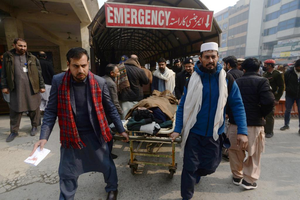
Islamabad, Jan 1 (IANS) The Human Rights Commission of Pakistan (HRCP) has expressed its deep concerns over the security and law and order situation in the country’s Khyber Pakhtunkhwa province throughout 2025. The region remains alarmingly unstable, witnessing frequent militant attacks.
Citing Islamabad-based Pakistan Institute for Conflict and Security Studies, the HRCP in its latest report titled 'Caught in the Crossfire: Civilians, Security and the Crisis of Justice in Khyber Pakhtunkhwa's Merged Districts' stated that at least 82 militant attacks had occurred nationwide in July 2025 alone, with Khyber Pakhtunkhwa, including its former tribal districts, accounting for nearly two thirds of this number.
Additionally, 45 militant attacks were recorded in the province in September 2025, killing 54 people and injuring 49.
Of these cumulative figures in September, the province's merged districts "accounted for 20 militant attacks claiming 21 lives" including six Pakistani security personnel, three militants and 12 civilians and injuring seven.
According to the HRCP, Mian Iftikhar Hussain, the President of the Awami National Party (ANP) in Khyber Pakhtunkhwa, described the security situation as significantly more precarious than generally perceived. He stated that a range of militant organisations were operating not only in the merged districts but also in settled areas of the province, adding that the terrorist outfit Daesh was reportedly active in the region.
Similarly, the rights body said, the provincial president of the Qaumi Watan Party (QWP), Sikandar Sherpao, claimed that “approximately 550 incidents of violence had occurred since January 2025, predominantly in the merged districts”. Citing Sherpao, the rights body stated that while "actual militant actors" were operating in the region, they were now accompanied by "copycat groups and hardened criminal networks, compounding the law-and-order challenges".
The QWP leader also identified the situation in Waziristan and the Bajaur region in Khyber Pakhtunkhwa as particularly grave, stating that the influence of the terror group Daesh or Islamic State Khorasan Province was "expanding to the extent that civil servants and police personnel felt compelled to go into hiding by late afternoon."
The HRCP mission further highlighted that the continued practice of enforced disappearances remains a cause for concern.
“The testimonies heard by the mission imply that persons accused of ‘anti-state’ activities are frequently not produced before the courts in accordance with constitutional guarantees. The mission observes that the reported political victimisation of rights-based movements such as the PTM (including arbitrary restrictions on members’ freedom of movement and assembly) and progressive parties such as the ANP is detrimental to democratic politics,” the rights body stated.
The HRCP also voiced alarm at reports of “censorship, intimidation and targeted attacks against journalists, particularly those covering enforced disappearances and militant violence” in the province.
--IANS
scor/as