
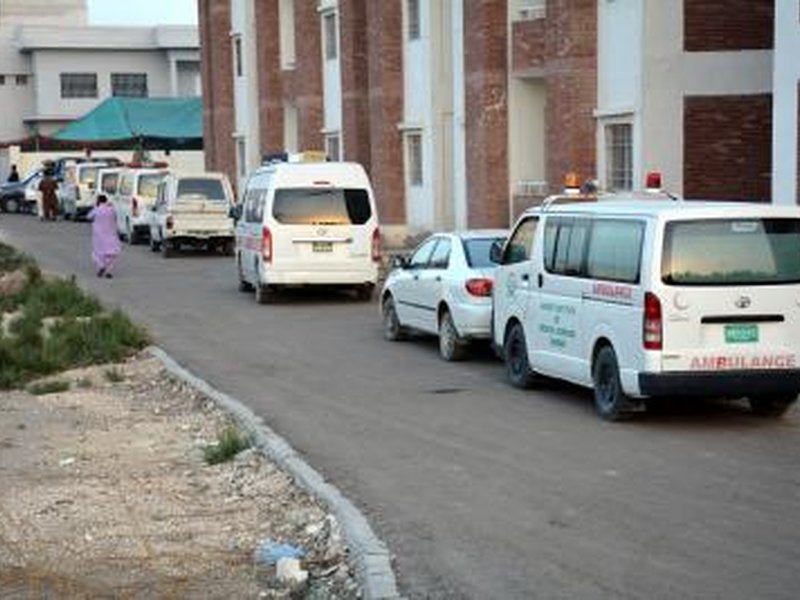
Islamabad, Dec 24 (IANS) Government hospitals in the city of Hyderabad in Pakistan's Sindh province continue to struggle to provide even the basic healthcare facilities to patients due to acute shortage of medicines, diagnostic facilities and functional medical equipment, majorly due to alleged poor oversight by officials of the health department, local media reported on Wednesday.
As per reports, Civil Hospital Hyderabad and all taluka hospitals in the city do not have essential medicines. Patients are unable to undergo routine laboratory tests at taluka-level facilities due to lack of basic machinery, resulting in patients being forced to undergo treatment in private hospitals and laboratories, where they are asked to pay thousands of rupees for preliminary check-ups, leading Pakistani daily 'The Express Tribune' reported.
The situation has deteriorated to the extent that the trauma centre constructed on Hala Naka Road has remained non-operational, causing burden on Civil Hospital Hyderabad, where patients come in large numbers for treatment from across Sindh. However, Civil Hospital itself is having non-operational equipment and inadequate treatment facilities.
Currently, Civil Hospital Hyderabad has only one MRI and one CT scan machine operational, while other diagnostic machines have remained non-operational for months. Situation at taluka hospitals in Hyderabad is reportedly worse as facilities like Sindh Government Bhittai Hospital Latifabad, Government Hospital Qasimabad, Kohsar Hospital Latifabad, Government Hospital Pretabad and Government Hospital Hali Road and several basic health units lack testing facilities and essential medicines, the newspaper report detailed.
Earlier this month, another report revealed that Pakistan, with a sharp increase in HIV cases, is ranked second among nations in the Asia-Pacific. The deepening HIV crisis in Pakistan is not only a medical emergency but also demonstrates institutional rot and showcases the consequences of years of neglect, the failure to implement basic health standards and the human cost of corruption.
The shocking statistics highlighted the use of contaminated syringes, unregulated blood transfusions, fake doctors and violations of medical rules. Health officials have reported 3,995 registered HIV-positive children in Sindh, a figure that only represents documented cases, according to a report in European Times. Recently, Sindh's Health Minister was briefed on what was described as an "extremely alarming" spread of HIV infections, especially among children, as per the report.
According to the data, more than 600,000 fake doctors practice in Pakistan, with 40 per cent of them based in Karachi. The figure demonstrates the deepening medical malpractice crisis in Pakistan. With insufficient oversight, these fake doctors operate freely, reusing syringes, mishandling blood, and conducting unsafe procedures that further increase the spread of HIV.
The few HIV treatment centres that are present in Pakistan face shortages of testing kits, antiretroviral medicines, and trained staff, resulting in diagnosis and treatment delay. Patients often suffer as they have to move from one hospital to another in search of basic care.
"Pakistan’s deepening HIV crisis is more than a medical emergency; it is a reflection of institutional rot. It exposes the consequences of years of neglect, the failure to enforce basic health standards, and the human cost of corruption. The tragedy of nearly 4,000 HIV-positive children in Sindh, the epidemic of quack doctors, and the routine use of contaminated medical tools together form a damning indictment of the state’s indifference. This is not a story of a virus spreading silently; it is a story of systemic failure that allows the virus to thrive," the European Times report detailed.
--IANS
akl/as