
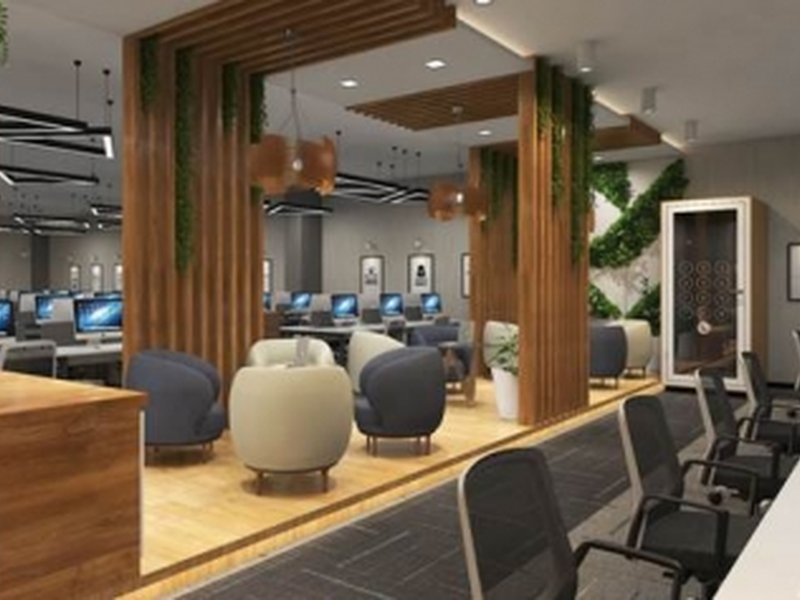
New Delhi, March 24 (IANS) India's flexible office inventory reached about 110–114 million square feet, marking a robust threefold increase between 2020 and 2025, a report said on Tuesday.
The inventory has grown at a 23-25 per cent CAGR over the past five years, the report from real estate consultancy CBRE and industry body FICCI said.
In 2025, flexible space demand was led by IT, technology, and software development companies, accounting for a 27-32 per cent share of the total deal volume, followed by BFSI and E&M at 9-14 per cent each, and business consulting and professional services at 7-12 per cent.
Further, global companies accounted for 55-60 per cent of the demand, with domestic companies accounting for the remaining 40-45 per cent.
"The country has emerged as one of the world’s fastest-growing large flexible workspace markets, marked by its unparalleled scale, cost-effectiveness, and advancing institutional maturity," the report said.
India currently has over 500 flexible workspace operators spanning across 2,600 locations. As of March 20, 2026, the total market capitalisation of listed flex players in India stood at around $2-2.2 billion, the report noted.
"Flex is now a core component of how India's leading companies plan and manage their real estate portfolios. Occupiers have moved well beyond experimentation with flex integrated into long-term portfolio planning, and demand is being shaped by workforce strategy and geographic flexibility. We expect this integration to deepen further through 2026," CBRE's Chairman and CEO, India, South-East Asia, Middle East and Africa, Anshuman Magazine, said.
Bengaluru is the largest flexible workspace market in India, with 30-32 million square feet of stock dominated by occupiers from the IT, technology and software development sector, BFSI, and Business Consulting and Professional Services, amongst others.
Delhi-NCR ranked second with 21-23 million square feet of stock, followed by Pune at 13.6-14.6 million square feet.
The report predicted the presence of institutional and public capital to shift flex growth towards more disciplined, network-led expansion, enhancing the sector’s long-term stability and reinforcing its role within India’s office market.
The adoption of flexible workspaces by Global Capability Centres (GCCs) will deepen over the medium term, driven by operational models that favour speed, scalability and standardised workplace environments, it forecasted.
—IANS
aar/vd