New Delhi, Feb 3 (IANS) With coordinated domestic and global initiatives, India is positioning itself as a reliable and competitive player in advanced materials value chains, taking decisive steps toward self-reliance in critical materials by establishing a domestic ecosystem for Rare Earth Permanent Magnets (REPMs), an official statement said on Tuesday.
The Rs 7,280 crore REPM Manufacturing Scheme and the Union Budget 2026–27 announcement of Dedicated Rare Earth Corridors together create an integrated framework for mining, processing, research, and manufacturing, the statement said.
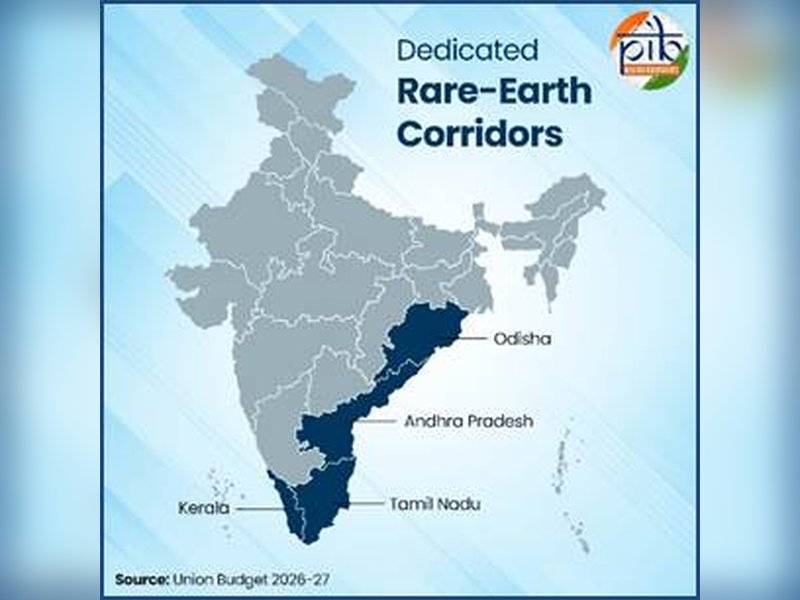
The Budget 2026–27 has announced the creation of Dedicated Rare Earth Corridors in Odisha, Kerala, Andhra Pradesh, and Tamil Nadu to promote mining, processing, research, and manufacturing.
According to the statement, Rare Earth Permanent Magnets (REPMs) are among the strongest types of permanent magnets, known for their high magnetic strength and stability.
Their compact size and powerful performance make them indispensable for advanced engineering applications such as electric vehicle motors, wind turbine generators, consumer and industrial electronics, aerospace systems, defence equipment, and precision sensors.
The country possesses a substantial reserve of rare-earth minerals, providing a strong foundation for downstream industries like REPM manufacturing.
India holds 13.15 million tonnes of monazite, containing an estimated 7.23 million tonnes of rare-earth oxides (REO). These deposits occur across Odisha, Kerala, Andhra Pradesh, Tamil Nadu, West Bengal, Gujarat, Maharashtra, and Jharkhand, primarily in coastal beach sands, teri/red sands, and inland alluvium.
In Gujarat and Rajasthan, 1.29 million tonnes of in-situ REO resources have been identified in hard-rock areas. The Geological Survey of India (GSI) has further augmented reserves, identifying 482.6 million tonnes of rare-earth ore resources in 34 exploration projects.
However, although India has a strong rare-earth resource base, domestic production of permanent magnets is still at a developing stage, with imports mainly from China, meeting most of the demand (nearly 60–80 per cent by value and 85–90 per cent by quantity between 2022–25).
With the consumption of Rare Earth Permanent Magnets expected to double by 2030 due to rapid growth in electric mobility, renewable energy, electronics, and defence applications, it is essential for India to expand domestic capability and invest in this sector to reduce import dependence and ensure long-term self-reliance, said the statement.
--IANS
na/