
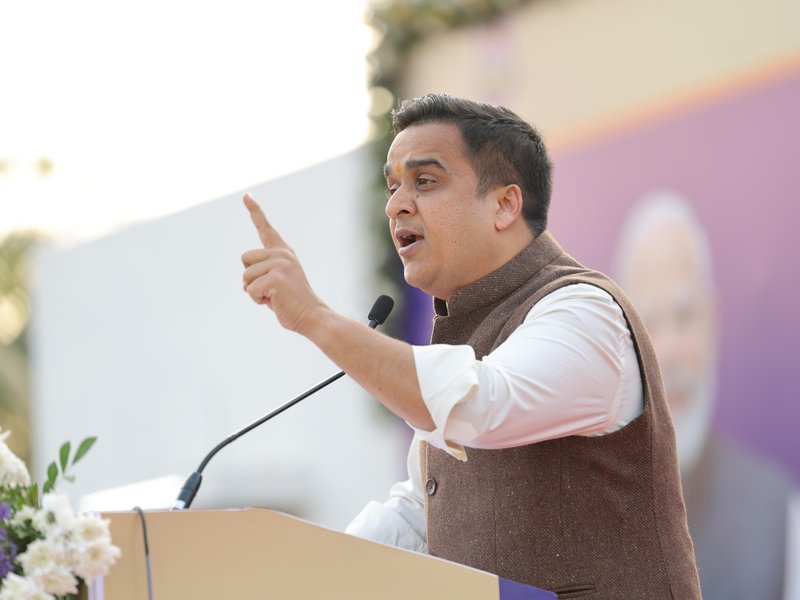
Gandhinagar, Feb 20 (IANS) The Bhupendra Patel government on Friday announced significant amendments to the Gujarat Registration of Marriages Act, 2006, aimed at making the marriage registration process more transparent and robust while safeguarding daughters and social traditions.
Deputy Chief Minister and Home Minister Harsh Sanghavi outlined the amendments in the state Legislative Assembly under Rule 44, calling them “extremely important and sensitive” for the protection of daughters and preservation of societal structure.
Under the new rules, parents will now be formally involved in the marriage registration process. “Marriage registration will now include parents, and a separate portal will be created for this purpose,” Sanghavi said.
Parents will receive formal notification, and their consent will be considered an essential part of the process.
Sanghavi emphasised that the government is not against love marriages but is committed to preventing deceit and coercion.
“Our government is not against love. We are committed to taking strict action against those who misuse the concept of love. Marriage is one of the 16 sacred samskaras. Tradition should not be violated by deceit. It is a serious matter if someone hides their identity to trap a daughter. The government cannot ignore this,” he said.
He further warned against attempts to exploit young women under false pretences. “If anyone, pretending to be someone like Salim Suresh, tries to trap a state’s daughter, this government will act in such a way that he will not even dare to look at any daughter in the future,” he added.
The announcement follows incidents in Panchmahal district, where hundreds of ‘Nikah’ certificates were issued in villages such as Kankodakui and Nathkuva, despite there being no Muslim families.
“Marriages conducted by hiding one’s identity are an attack on our culture. This government is a protector of every daughter’s honour and our ancient traditions,” Sanghavi said.
The amendments are also designed to close loopholes in the existing system, ensuring accountability and transparency.
The registration process requires both parties and two witnesses to submit a notarised application along with identification proofs such as Aadhaar cards, passports, or driving licences. Parents must provide their full names, addresses, Aadhaar numbers, and mobile numbers.
The Assistant Registrar will notify parents within 10 working days and forward the application to the district or taluka Registrar. Registration will be completed after 30 days of verification, and a certificate will be issued through an online portal, including serial number, page number, and volume details.
Sanghavi said the government had consulted Chief Minister Bhupendra Patel and held 30 rounds of discussions with social organisations. “To preserve our social structure and prevent injustice, digitisation of the registration process and the presence of local witnesses will ensure accountability,” he said.
Public objections and suggestions on the new rules are being invited over the next 30 days through the Health and Family Welfare Department’s official website.
A committee will review the submissions within constitutional limits before final implementation.
Reflecting on the cultural and social significance of daughters, Sanghavi said, “When a daughter is born, she grows in her father’s courtyard like the Tulsi plant. Love marriages are not opposed, but strict action will be taken against deceit and coercion. This government is the protector of every daughter’s honour and our ancient traditions.”
--IANS
mys/dpb