
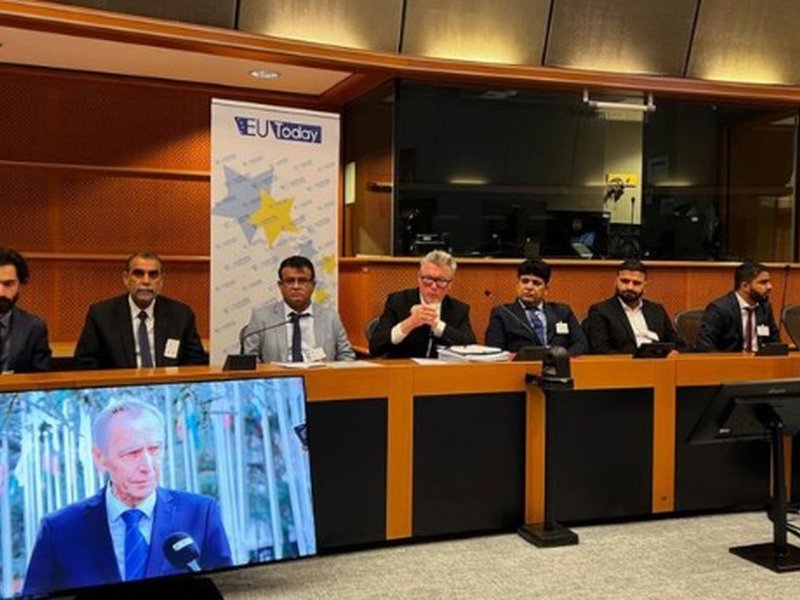
Brussels, Dec 6 (IANS) The Baloch National Movement (BNM) attended a conference at the European Parliament, presenting evidence of Pakistan's human rights violations across Balochistan and calling for a re-evaluation of Islamabad's preferential trade status under the Generalised Scheme of Preferences Plus (GSP+) in light of the grave abuses.
Hosted by the EU Today, the conference examined whether Pakistan should continue to enjoy preferential trade access to the European market under GSP+.
Speaking at the event, Chairman of the Baloch National Movement (BNM), Naseem Baloch, stated that in recent years, Pakistan's security establishment has intensified its campaign of repression in Balochistan, with peaceful political leaders, students, human rights defenders, and political activists targeted with a level of ferocity meant to silence an entire generation.
"In just the last three months of 2025, 234 new cases of enforced disappearance were recorded. Women such as Nasreena Baloch and Mahjabeen Baloch, abducted earlier this year, remain missing. Thousands of Baloch civilians have been forcibly disappeared over the past two decades, and thousands have been killed in custody. Mass graves have been found in multiple regions over the last decade. In Dasht, near provincial capital Quetta, a cemetery known as the 'cemetery of the unknowns' holds hundreds of unidentified bodies -- sons, brothers, fathers who vanished and returned only as nameless remains," Naseem stated.
He said that this is "not just a narrative invented by political movements", but has also been documented by UN working groups, Amnesty International, front-line defenders, and major international media organisations.
"The world cannot claim ignorance -- the evidence is overwhelming," he added.
The BNP chairperson further said that the situation has taken a more dangerous turn in recent months as Pakistan has deployed armed drones over Balochistan, targeting civilian areas. In Zehri district, he said, drone strikes killed four children and several other civilians.
"Villages that once feared checkpoints now fear the sky itself. This is not counterterrorism; it is the use of advanced weaponry against an unarmed population -- this is a war crime," Naseem stated.
The Baloch leader further added that while Balochistan bears the deepest wounds, other marginalised nations -- Pashtuns, Sindhis, Christians, Ahmadis, Hindus, and the people of Pakistan-occupied Gilgit-Baltistan and Pakistan-occupied Kashmir face similar patterns of enforced disappearance, arbitrary detention, and political repression.
"This is not a regional issue -- it is structural," he stressed.
Emphasising the pivotal role of the European Union, Naseem stated that Pakistan continues to benefit from GSP+, a mechanism designed to promote compliance with human rights, labour standards, and good governance, yet Pakistan has systematically violated these conditions.
"I request this Parliament to give full weight to the findings of UN Working Groups and the calls of Amnesty International and Front Line Defenders. I urge you to reassess Pakistan's GSP+ status in light of overwhelming evidence," he noted.
--IANS
scor/sd/