
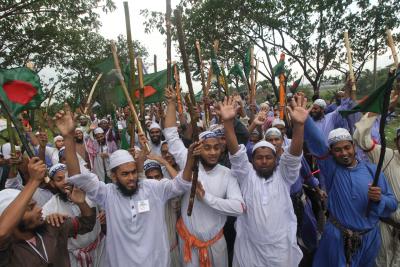
Dhaka, April 27 (IANS) Mob violence in Bangladesh has ceased to be an isolated phenomenon and is now emerging as a broader crisis, with waning trust in the country's justice system, a report said on Monday.
Citing data from Dhaka-based rights group Ain o Salish Kendra (ASK), Nazrul Islam, a retired Major General of the Bangladesh Army, wrote in Bangladeshi daily ‘The Business Standard’ that mob attacks resulted in 128 deaths in 2024 and rose to 197 in 2025. Following the political transition in August 2024, he said, as many as 293 people were killed in mob violence.
He also referred to other estimates, which documented more than 400 incidents between August 2024 and early 2026. Despite inconsistencies in reporting, Islam said, the broader trend is evident: "Mob violence is increasing in both levels and frequency."
Earlier, on April 11, in the Daulatpur region of the Kushtia district in Bangladesh, Abdur Rahman, a spiritual figure, was killed by a mob after a video circulated on social media alleging that he had made offensive comments against religious sentiments.
“On this unproven assertion, a mob was formed, assaulted him, ransacked his shrine, and burnt it. No complaint was made, no inquiry was conducted, no trial was held – just a rumour, which in a few hours had been reduced to a death sentence. It was one of a trend that is gradually becoming established,” Islam stressed.
Emphasising that policies alone are insufficient, the former Bangladeshi army officer observed that although large crowds are often present in most incidents, very few attempt to intervene.
“This reveals a difficult truth — mob culture persists not only because some act violently but also because many remain passive. Kushtia compels us to confront that reality,” he noted.
Islam said Bangladesh has adequate laws to deal with mob violence, stressing that the issue is not legislation but enforcement. He added that mobs become emboldened where enforcement is inconsistent or discriminatory.
“Unless justice is perceived to have been served, the message that is propagated is dangerous. Bangladesh is at a crossroads. It is not a question of whether there should be a law, but rather whether there should be an enforced law or a law that has been ignored. Such a decision will make the future of the country,” he asserted.
--IANS
scor/as