
Washington, Jan 17 (IANS) An immersive art exhibition and documentary screening on Capitol Hill has brought into sharp focus the plight of Hindu and other minority communities from Pakistan, highlighting forced conversions, abductions, and a refugee crisis that organisers say has remained largely invisible in global discourse.
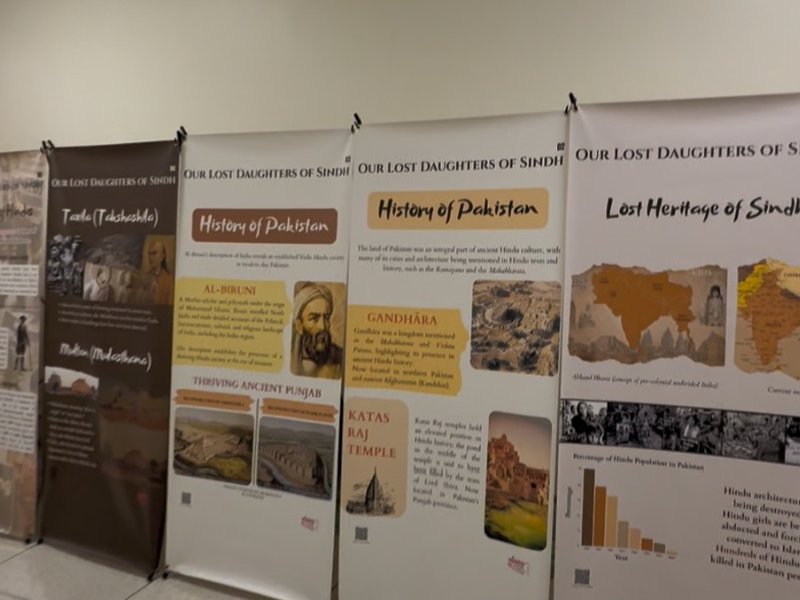
Titled Seven Decades and supported by HinduAction, the exhibition combines photography, large-format visual installations, quilts, and film to convey what organisers describe as a "silent refugee crisis".
The event sought to sensitise US lawmakers and congressional staff to what activists called widespread and systemic abuses faced by minorities, particularly Hindus, in Pakistan, as well as the experiences of refugees who have fled to India.
Kiran Chukkapalli, founder of the Refugee Aid Project, said the exhibition documents the lives of refugees who have escaped persecution and are now living in camps across India.
"We host about 92 refugee camps across India, and we have about 383,000 Hindu, Sikh, Buddhist refugees," he said, describing the display of black-and-white photographs, long visual panels, and textile art as an effort to make their stories visible.
"We call it the silent refugee crisis," Chukkapalli added, noting that such communities rarely feature in mainstream global conversations on displacement.
One prominent installation, the 'Goddess Quilt', was described as symbolising the resilience of women who, Chukkapalli said, have rebuilt their lives after enduring persecution.
Other sections, including what he called the "absence series", focus on loss and silencing, portraying homes left behind and disrupted traditions.
The exhibition has previously been shown in cities including Sydney, Melbourne, London, New York, and Mumbai, he said, but bringing it to Washington carried particular significance.
"This issue should be a mainstream issue… their voices deserve to be heard," he said.
Alongside the exhibition, a short film and documentary screenings addressed forced conversions and abductions in Pakistan.
Rahul Sharma, founder of the humanitarian group Indus Valley Minorities, said his organisation works directly with victims and families, representing them at police stations, courts, and hospitals.
"We actually go and work on the ground… we run rescue operations as well," Sharma said, describing cases in which minor Hindu and Christian girls are kidnapped, sexually assaulted, forcibly converted and married, often making a return to their families nearly impossible.
Sharma said his organisation receives "about one case a week" involving what he described as brutal crimes. He added that the short film he produced in Mumbai was intended to help lawmakers "really visualise what happens", calling it a "hard-hitting" depiction of forced conversions.
An interactive walkthrough element of the exhibition used reconstructed domestic spaces and testimonial narratives to depict what organisers called an organised system involving traffickers, clerics, political figures, and complicit officials.
The accompanying documentary traced what was described as the mechanics of abduction, rapid conversion, and marriage, and the role of poverty and vulnerability in targeting minority girls.
Utsav Chakraboty, from HinduAction, said the aim was also to draw attention to the status of Hindus in Pakistan.
Noting that Hindus make up "barely one and a half per cent of the population" in Pakistan, he said they are "hounded, kidnapped and forcibly converted", adding that similar concerns are emerging in Bangladesh amid the rising political influence of Islamist groups.
Event organisers appealed for greater awareness and engagement from US lawmakers, with organisers arguing that ignorance has contributed to inaction. "We believe that as Hindus in America, we have a role to play in ensuring that our lawmakers… are aware of what's going on," Chakrabarty said.
The Capitol Hill exhibition reflects a growing effort by diaspora organisations to use art, film and testimony to bring these issues into international policy spaces, framing documentation itself as a form of resistance and remembrance.
--IANS
lkj/sd/