
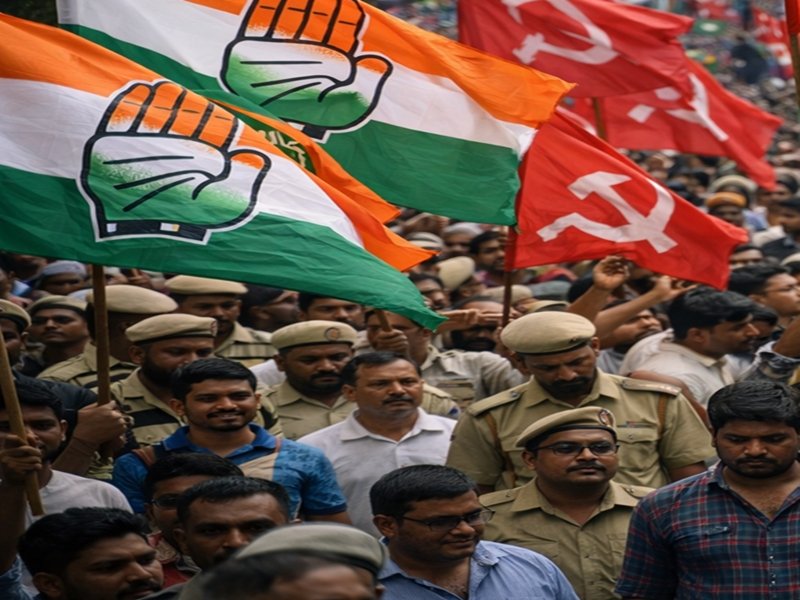
New Delhi, Dec 17 (IANS) While the Communist Party of India (Marxist) in Kerala earlier this week ruled out any understanding with the Congress against Bharatiya Janata Party's (BJP) growing influence in local bodies, a breakup of the former two is expected in West Bengal where they allied against the ruling Trinamool Congress.
Ironically, all the three political parties opposed to the BJP are part of the Indian National Developmental Inclusive Alliance (INDIA) bloc.
In Kerala, the ruling Left Democratic Front (LDF) is led by the CPI (M), and the Congress is the principal constituent of the Opposition bloc United Democratic Front (UDF).
The UDF did better in the recently concluded local body polls in Kerala compared to the LDF, while the BJP evolved as a potential third force following a high‑visibility breakthrough in Thiruvananthapuram.
In West Bengal, the BJP has evolved as the principal Opposition, edging out both the Congress and the Left from the Assembly.
Incidentally, Assembly elections are due in both Kerala and West Bengal next year. The Congress in West Bengal is signalling a push to contest largely on its own after facing disappointments in successive polls.
The Left Front is divided, where the CPI(M) seems ambivalent, but some of its allies remain opposed to a formal alliance with the Congress.
These constituents have pointed out that poll results have shown that while their votes largely consolidated in favour of an alliance partner, it did not with Congress electors.
For many Congress functionaries and supporters, alleged atrocities under Left rule are among reasons said to prevent vote consolidation.
Whereas, the present generation of Communists or their sympathisers do not recall much of the pre-1977 Congress rule in West Bengal. In fact, despite the Congress-Left alliance, the parties chose to contest separately in six Assembly seats where repolls were held last year after the incumbent MLAs were elected to Lok Sabha.
Senior leaders of Congress have reportedly hinted workers to prepare to be “self‑reliant”, rather than another seat‑sharing pact.
This reflects a strategic shift after recent poor showings and a desire to rebuild the party’s base in the state.
With the 2024 repoll contest fresh in memory, Left Front allies such as the All India Forward Bloc and the Revolutionary Socialist Party have objected to sharing seats with Congress and are demanding larger allocations of seats if talks at all proceed.
Reports from ground and media coverage frame the situation as “uncertain” with grassroot demands, call for “fairer” number of seats, and recent electoral lessons -- especially from Bihar -- feeding caution on both sides. Both Congress and the Left are sensitive to who concedes which seats after the setbacks.
While the Congress would want to rebuild its identity rather than be subsumed, smaller Left allies fear further marginalisation within any broad arrangement. Anti-Trinamool, anti-BJP votes stand to be further divided if Asaduddin Owaisi’s All India Majlis-e-Ittehadul Muslimeen (AIMIM) enters the fray, either by itself or in alliance with the political outfit that proposed “Babri Masjid” builder Humayun Kabir is soon expected to launch.
However, in case of a polarisation along religious lines and fragmentation of Muslim votes, the ruling party stands to face uncertainty.
--IANS
jb/pgh