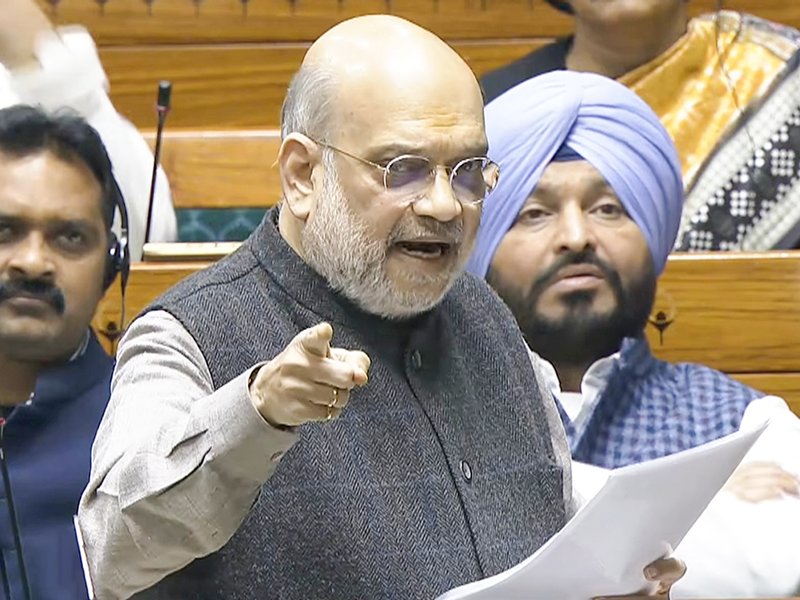
New Delhi, Dec 10 (IANS) Union Home Minister Amit Shah, participating in a discussion on election reforms in Lok Sabha on Wednesday, rebutted every point raised by Congress leader Rahul Gandhi in his “vote theft” allegations, and cited instances of electoral manipulation by the Opposition itself.
He delivered his statement amidst repeated interruptions from the Opposition benches, where he was even forced to sit down on occasions, even as Speaker Om Birla was seen trying to bring the House in order.
The Home Minister took a jibe at the Congress leader's “nuclear bomb” press conference and pointed out the anomalies in his allegations. He cited Gandhi’s claim of more than 500 voters being shown on Haryana’s voter list to be from the same residential address. HM Shah gave reference to the Election Commission of India (ECI), having clarified that the residence “House No. 265” is spread over a one-acre ancestral plot, housing several families in separate dwellings.
In this case, separate numbers had not been allotted to individual houses. “There could be three generations of family members living in a house,” the Bharatiya Janata Party (BJP) leader said, referring to the poll body’s clarification, then adding, “they would have exercised their franchise even in Congress’s regime in Haryana.”
His ‘counter bombshell’ stunned the Opposition with his claim that a voter from Bihar had been forced by the Congress party to share false statements over voter list anomalies. In another instance, the Home Minister cited how Congress leaders themselves had resorted to “vote theft”, much to the chagrin of the Opposition benches, who burst into loud protests. After India’s Independence, “When the Congress decided on a mandate from regional chiefs to decide who should be the Prime Minister, Jawaharlal Nehru got two votes to Sardar Vallabhbhai Patel’s 28,” he claimed.
“Yet, Nehru became the Prime Minister,” he added. HM Shah also referred to an Allahabad High Court judgement in June 1975 declaring void Indira Gandhi’s victory from Rae Bareli constituency, after Opposition leader Raj Narain moved it against alleged electoral malpractice.
Incidentally, the ruling had led to a huge political upheaval in India, including the imposition of the Emergency in 1975 by Indira Gandhi.
To Rahul Gandhi’s query on the National Democratic Alliance (NDA) government led by Prime Minister Narendra Modi having enacted a law protecting the Election Commissioner against legal proceedings, the Home Minister reminded him how the Congress had made sure that Prime Ministers remain similarly immune. HM Shah defended SIR as the exercise necessary for the “purification” of voter rolls, tracing its precedent to the time of Jawaharlal Nehru’s government, pushing back against Opposition interruptions.
He described it as a process to “clean and purify electoral rolls”, removing the deceased, those who have migrated or transferred, and foreign nationals, and to include new voters. Arguing its historical precedent in India’s electoral management, the Home Minister pointed out that the first three exercises were conducted during Nehru’s regime, one under Lal Bahadur Shastri, followed by Indira and Rajiv Gandhi, then Narasimha Rao as Prime Ministers. All these were when the Congress was in power. Only once was there a non-Congress government led by Atal Bihari Vajpayee, but that process too ended when Manmohan Singh came in 2004 to head a coalition government.
“There has never been any complaint or protest till it resumed when our government is in power,” he reminded that there has been no SIR of electoral rolls between 2004-2025. Earlier, a returning officer could delete names of deceased, double entries, etc, but “in 2010, the Chief Election Commissioner decided against it,” the Home Minister reminded the House. Thus, SIR is necessary for the revision and update of the voters’ list, he contended. He was firm in his rebuttal and against attempts at disruptions.
When repeatedly interrupted, HM Shah asserted control of his speech, saying “I will decide the order of my speech”, underscoring his insistence on Parliamentary decorum and his long legislative experience.
--IANS
jb/uk