

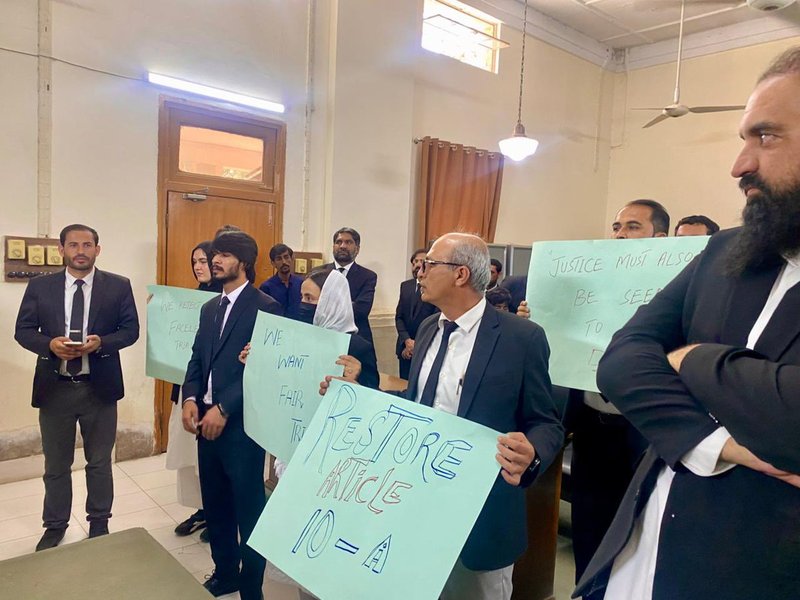
Islamabad, Aug 28 (IANS) The honest lawyer in Pakistan watches his practice shrink while those who guarantee illicit outcomes thrive in the country, resulting in many capable lawyers forced to leave the profession or struggle to continue their practice as they refuse to compromise on their principles, a report has detailed.
The legal profession is considered one of honour in the world. However, the profession in Pakistan has increasingly become linked to hooliganism and corruption in the minds of people. Years of such practices have undermined people's trust in Pakistan's justice system, a report in 'The Friday Times' detailed.
"This has been caught on by litigants as well, who now know that a 'clean' case is a gamble, so they either pay a premium for a lawyer who guarantees the outcome, or they skip the courtroom altogether and settle quietly outside it. These practices have led to honesty being bad for business. A lawyer who has mastered his field can lose out to one who has mastered nothing except securing favourable outcomes through illicit means, since the latter promises something the first won’t, which is a guaranteed win," Mustafa Arif wrote in Pakistan's leading daily 'The Friday Times'.
"The inevitable consequence is that competence is overshadowed by connections, and integrity becomes commercially unsustainable. The honest lawyer, who knows the law, watches his practice shrink, whereas the one who knows the right people and can bend the system to his will thrives. Resultantly, many capable lawyers are forced to abandon the profession or struggle to sustain their practice simply because they refuse to compromise their ethics," the author added.
Furthermore, he emphasised that the 26th and 27th Amendments have weakened the constitutional authority of Pakistan's Supreme Court and given powers to the newly created Federal Constitutional Court. These amendments have increased the executive's influence on who gets appointed to the bench. The judges get appointed from their inner circles, like the former chamber fellows, juniors, caste favourites, bar-political loyalists and members of entrenched patronage networks, which results in judges not being appointed on constitutional merit.
Last month, the International Federation for Human Rights (FIDH) said that judicial corruption in Pakistan is at systemic scale and may amount to grand corruption. It also warned that the justice system of the country has become increasingly vulnerable to political influence and institutional capture.
The FIDH made the observations in a report titled 'Under the Bench: Mapping Corruption Risks in Pakistan's Justice System'. It said that judicial corruption in Pakistan has serious human rights implications, including violations of due process and equality before the law, especially affecting low-income communities and minorities, Pakistan's Dawn reported.
As per the executive summary, Pakistan's democratic institutions, including the judiciary, have been experiencing increasing pressure over the past several years and have been facing gradual weakening and capture by the executive branch.
"This has been accompanied by severe repression of fundamental freedoms, facilitated by repressive legislation and grave violations of human rights. In this context, the judiciary has become a tool for repression and silencing of activists and dissidents," it said.
The report said its findings are based on interviews with 30 interlocutors, including four women, who have knowledge about Pakistan's justice system. Those interviewed included lawyers, former and retired judges, journalists and and representatives of civil society organisations.
According to the report, the 26th and 27th Constitutional Amendments have had a negative impact on judicial independence and the protection of fair trial rights in Pakistan, Dawn reported.
--IANS
akl/as