
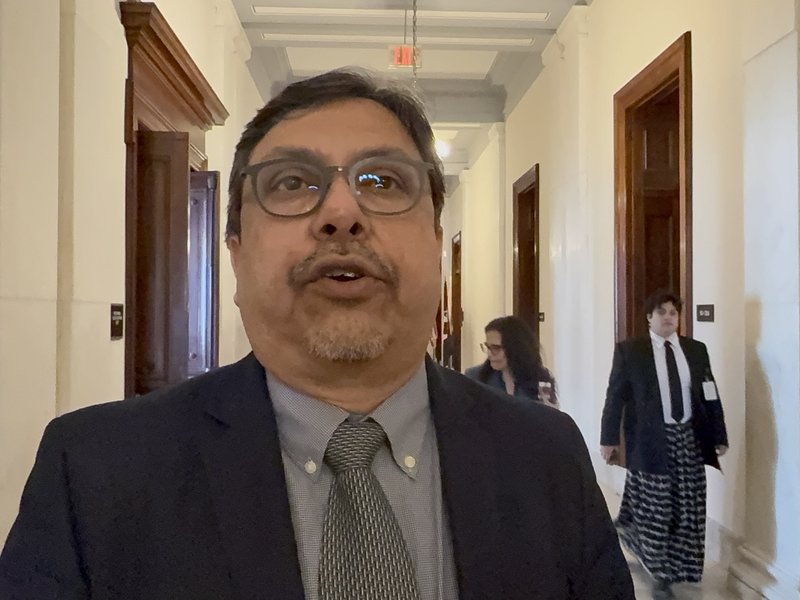

Washington, Jan 16 (IANS) India’s upcoming Union Budget is expected to broadly stay the course, with the government maintaining its focus on fiscal consolidation, macroeconomic stability and stepped-up investment in high-technology sectors, according to Anit Mukherjee, Senior Fellow at ORF America, who has worked extensively on fiscal and development policy.
“I’m expecting more of the same because this is the midpoint of this term, of this government,” Mukherjee told IANS in an interview, signalling continuity rather than major policy shifts in the forthcoming budget.
He pointed to recent announcements as evidence of an incremental approach, particularly the restructuring of India’s largest social benefit programme, earlier known as MGNREGA, which is being reoriented toward livelihoods rather than remaining primarily a direct benefits transfer scheme.
“So we already have seen some announcements which are really important,” he said, adding that the programme is now being redesigned “towards more of a livelihoods program other than a direct benefits transfer.”
On the fiscal side, Mukherjee said revenue growth was likely to remain strong despite recent cuts in the goods and services tax (GST). He noted that the external sector remained stable, offering room for cautious optimism as global trade patterns evolve.
“The external sector is stable,” he said, observing that even a degree of trade reorientation could work in India’s favour.
He suggested that a relative weakening in India’s traditional trade groupings could prove beneficial if the country shifts trade away from the United States toward other partners, with a potentially positive impact on the current account balance reflected in the budget.
Overall, Mukherjee said he expected the finance minister to remain focused on core macroeconomic objectives. “I expect the finance minister to keep the eye on the ball,” he said, stressing the importance of fiscal consolidation, keeping the fiscal deficit in check and managing moderate inflation.
He also underlined the need for sustained public investment in emerging and strategic sectors where India’s competitiveness is already visible. “We are poised to make significant investment in high technology, in AI, in many of these sectors where Indian competitiveness is already showing and will need to be more investment needs to go into those sector,” he told IANS.
Mukherjee also weighed in on changes to the revamped rural employment programme, drawing on his experience studying its impact across several Indian states. He noted that the project had been in operation for nearly 20 years with little change to its core structure, even as the Indian economy and labour-market needs evolved.
“I think if you look at how long [the programme] had been in operation, it’s nearly 20 years,” he said, adding that “the general structure… didn’t change, so it was time for a change ’cause the Indian economy has changed, the needs that have changed.”
Describing the reform as “a good step” and “a step in the right direction,” Mukherjee said the overhaul modernises databases and management systems while giving states more autonomy in implementation. At the same time, he cautioned against losing sight of the programme’s original intent.
“The whole idea… was to provide employment when people needed it during the fallow season, during, during a drought, for example,” he said, emphasising that with climate change, the employment guarantee aspect would remain critical even if the nature of jobs changes.
Mukherjee also addressed the impact of US trade and tariff measures on India, saying the immediate effects had already been felt since the tariffs were imposed several months ago. “We should have seen that immediate impact already because the tariffs were imposed in April,” he said.
He noted that roughly $50 billion worth of goods trade had been affected, though he added that the Indian government had taken steps to mitigate the impact on domestic industry. Despite this, Mukherjee said there remained optimism around the possibility of a bilateral free trade agreement.
“There is optimism about an FTA,” he told IANS, adding that if such an agreement were to materialise, “there’s likely to be a positive, um, feedback on the Indian economy and the sentiment.”
India’s Union Budget sets out the government’s fiscal priorities, tax policies and spending plans for the coming financial year and is closely watched by investors, businesses and state governments for signals on growth strategy and macroeconomic management.
--IANS
lkj/rs