
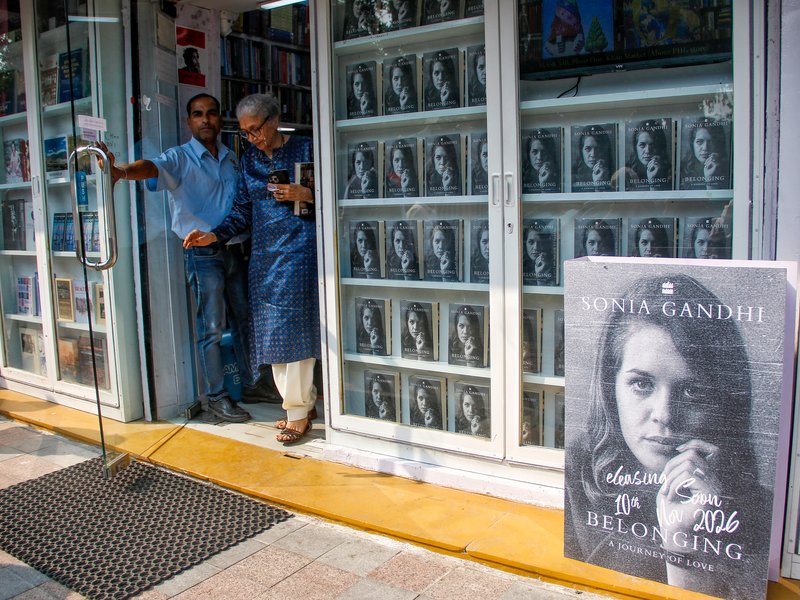
New Delhi, Nov 10 (IANS) Congress veteran Sonia Gandhi's much-awaited memoir, ‘Belonging: A Journey of Love’, which hit bookstores on Tuesday, has attracted attention for its personal revelations about the Nehru-Gandhi family and her political journey. However, the book has also come under scrutiny after readers spotted at least three apparent factual inaccuracies relating to important political and historical events.
Discrepancies in different chapters have raised questions about the accuracy of some historical references. The first apparent error concerns the anti-corruption movement led by social activist Anna Hazare, which posed a major challenge to the Congress-led United Progressive Alliance (UPA) government.
In Chapter 33, page 461, Sonia places the emergence of Hazare and the India Against Corruption movement in 2012. "In 2012 a well-known activist from Maharashtra, Baburao 'Anna' (Marathi for 'father' or 'elder brother') Hazare, emerged as the figurehead of a movement that titled itself 'India Against Corruption'," the memoir states.
However, the movement gained national prominence in 2011, particularly after Hazare began an indefinite hunger strike at Delhi's Jantar Mantar on April 5 that year, demanding a stronger anti-corruption law through the Jan Lokpal Bill. The campaign also brought together prominent figures, including Arvind Kejriwal, Kiran Bedi and Baba Ramdev, although their positions and demands differed.
Another discrepancy appears in Chapter 24, page 338, concerning the Rashtriya Swayamsevak Sangh (RSS). "The RSS, founded in 1921, dreamed of a 'Hindu nation' that would replace constitutional ideals of equality, pluralism, and secularism with second-class citizenship for Muslims, Christians, and other religious minorities in India," Sonia writes.
The organisation was actually founded on September 27, 1925, in Nagpur by Keshav Baliram Hedgewar, a doctor by profession. It subsequently grew into one of India's most influential ideological and organisational movements.
The third error concerns veteran Congress leader Ahmed Patel, Sonia's political secretary and one of her closest political confidants.
In Chapter 29, page 401, she writes: "He came to wield considerable influence across the political spectrum but could be unforgiving towards those who crossed him. He remained my political secretary till, sadly, he fell victim to the Covid epidemic in 2022, leaving a vacuum in the party and an absence I felt personally".
Patel died on November 25, 2020, not 2022, following multiple organ failure after Covid-19 complications.
He was treated at Medanta Hospital, where his condition deteriorated, and he was admitted to the intensive care unit. His body was later taken to his ancestral village in Gujarat for burial. These three apparent errors have added an unexpected factual controversy to the release of Sonia Gandhi's memoir.
--IANS
brt/dan