
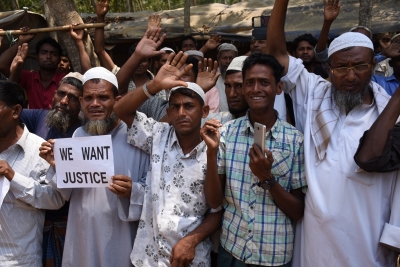
Dhaka, June 13 (IANS) The Rohingya refugee crisis in Bangladesh is slipping into a more dangerous phase, evolving from a large-scale humanitarian emergency into a serious security concern with implications extending from local communities to the broader region.
The rise of militancy in and around the Rohingya camps is not merely a law-and-order challenge but reflects a prolonged humanitarian crisis shaped by stalled repatriation, continuing instability in Myanmar, and the absence of viable prospects for a displaced population.
Bangladesh now faces the complex task of ensuring security within the camps while upholding essential humanitarian safeguards, a report has stated.
"Bangladesh's Rohingya refugee camps, especially those in Cox’s Bazar, are increasingly becoming spaces where humanitarian vulnerability and armed-group violence overlap. Recent incidents in 2026 point to a troubling pattern: the camps are no longer affected only by isolated criminal rivalries but by a more sustained and fragmented contest among multiple Rohingya armed groups seeking territorial control, influence, recruitment networks, and access to illicit economies,” a report in Stringer Asia detailed.
The report noted that the level of violence in these camps remains a cause of concern. Citing partial data compiled by the Institute for Conflict Management, the report said that at least four people had been killed and three injured in Rohingya-insurgency-linked incidents in Bangladesh up to May 24 this year. It added that 37 were killed in 2025, while 42 deaths were recorded in 2024.
Raising further concerns over the possible emergence of transnational extremist linkages, the report said, “In May 2026, Bangladeshi police arrested a Rohingya youth in Teknaf for alleged involvement with Tehreek-e-Taliban Pakistan through an Urdu-language WhatsApp group accused of encouraging terrorist activity. Earlier, in April, four ARSA cadres were arrested in Dhaka for alleged links with TTP.”
“These cases do not yet prove the existence of a formal TTP infrastructure inside the Rohingya camps, but they do reveal the vulnerability of displaced Rohingya youth to online radicalization and external extremist narratives. Prolonged statelessness, unemployment, insecurity, and frustration create conditions in which digital propaganda can find receptive audiences,” it added.
The report noted that at the heart of the crisis is the unresolved status of the Rohingya people. It cited United Nations High Commissioner for Refugees (UNHCR) 2026 data indicating that around 149,769 Rohingya refugees were newly registered in Bangladesh between December 2024 and March 31, 2026, taking the total registered Rohingya refugee population in Bangladesh’s camps to approximately 1,194,123.
“This continued displacement reflects the failure to create safe, dignified, and voluntary conditions for return to Myanmar,” it added.
Stressing the need to address the structural roots of displacement, statelessness, and political exclusion, the report said that armed factions will otherwise continue to find space to recruit, intimidate, and expand their influence in these refugee camps.
--IANS
scor/as