
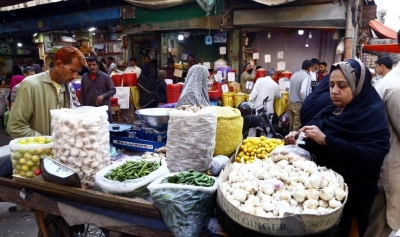
Islamabad, Jan 5 (IANS) With Pakistani households forced to spend nearly two-thirds of their income on food and electricity, the economy has ceased to be about growth and has become one of survival, a report said on Monday.
Citing the Pakistan Bureau of Statistics' latest Household Integrated Economic Survey, it revealed that life in Pakistan has increasingly become a matter of basic survival.
“Food alone now absorbs more than a third of household spending. Another quarter goes into housing, electricity and gas. Together, these basic needs consume 63 per cent of total expenditure. This is the direct result of prolonged inflation and policy choices that have steadily raised the cost of essentials. Incomes have risen on paper. They have not kept pace in reality. While average monthly earnings have increased over the past six years, household spending has risen faster. What families gain in nominal income is eroded by higher prices,” Pakistani daily The Express Tribune detailed.
The report noted that the shrinking purchasing power of the Pakistani rupee is reflected in what households can no longer afford.
“Spending on education has dropped to just 2.5 per cent. It is now less than half the cost of housing and utilities. Health and recreation together make up barely a few percentage points. A society that cuts back on learning and well-being is paying for stability today by mortgaging its future,” it mentioned.
According to the report, this is not resilience, but fragility disguised as coping.
Highlighting the steps to be taken, it said, “First, stabilising the cost of food and power must become an economic priority, not an afterthought. Second, inflation control must move beyond interest rates. Supply-side failures in food markets need fixing. And third, education and health spending need insulation from economic shocks. Household budgets are under siege.”
“If policy continues to treat survival as an acceptable equilibrium, the long-term costs will be far greater than today's fiscal discomfort,” the report added.
Last week, a report in Japan-based media outlet Nikkei Asia highlighted that Pakistan stares at several economic challenges in 2026 amid continuing low economic growth, recurring militant attacks and potential disasters related to climate change.
“Pakistan must intensify the pace of its internal reforms, notably to tackle conditions surrounding the bulk of its population. More than 40 per cent of Pakistan's population of roughly 257 million people live in abject poverty. Besides, the country has an alarming level of illiteracy, with just under 40 per cent of the population considered illiterate,” the report stressed.
--IANS
scor/as