
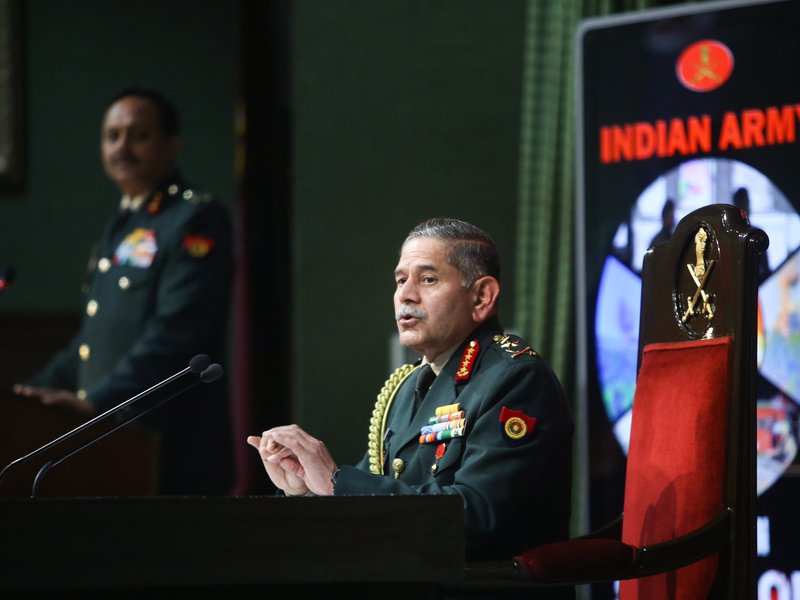
New Delhi, Jan 13 (IANS) Indian Army chief, General Upendra Dwivedi, on Tuesday said that there were no talks about nuclear warfare between the Directors General of Military Operations (DGMOs) of India and Pakistan during Operation Sindoor.
The scale of destruction caused in Pakistan due to India's resolute action against terrorism was only possible because the armed forces expanded the conventional space, Gen Dwivedi said at the annual press conference ahead of the Army Day on January 15.
"As far as nuclear rhetoric is concerned, I would like to clarify that there was no discussion on the nuclear issue in the DGMO talks. Whatever nuclear rhetoric was given by the politicians or the local public in Pakistan. I have no indication that anything of that sort came from the military," he said.
Stressing the importance of conventional operations, the Army chief said: "When we talk about our role in this, and when we discuss what was said earlier, it was stated that the space for conventional operations is shrinking, and that we would go directly from sub-conventional to the nuclear domain."
"However, the action we took this time, especially keeping in mind the kind of firing that took place in Jammu and Kashmir, and the way we addressed it, and how we eliminated approximately 100 of their (Pakistan) personnel -- all of it was possible because we expanded the conventional space."
"In those 88 hours, you saw that the army's mobilisation to expand the conventional space was such that if Pakistan made any mistake, we were fully prepared to launch ground operations," Gen Dwivedi added.
The Army chief said that eight terror camps, of which two are near the International Border (IB), and six across the Line of Control (LoC), are still active, and security forces are keeping a close watch on them.
In response to a question from IANS, he said: "According to our information, eight terrorist camps are still active, two of which are in IB and six are across the LoC. We do believe that there is some kind of presence or training in these camps, and that is why we are keeping a close watch. In case similar action is enacted, we will definitely deal with it."
He also mentioned that the forward movements that took place during Operation Sindoor have been "gradually reduced" by both countries, but vigilance is being maintained.
"As far as our eyes and ears are concerned, because Operation Sindoor is still on, those eyes and ears will remain open. Under this, whatever action we have to take, we have already taken it forward," he added.
--IANS
sd/vd