
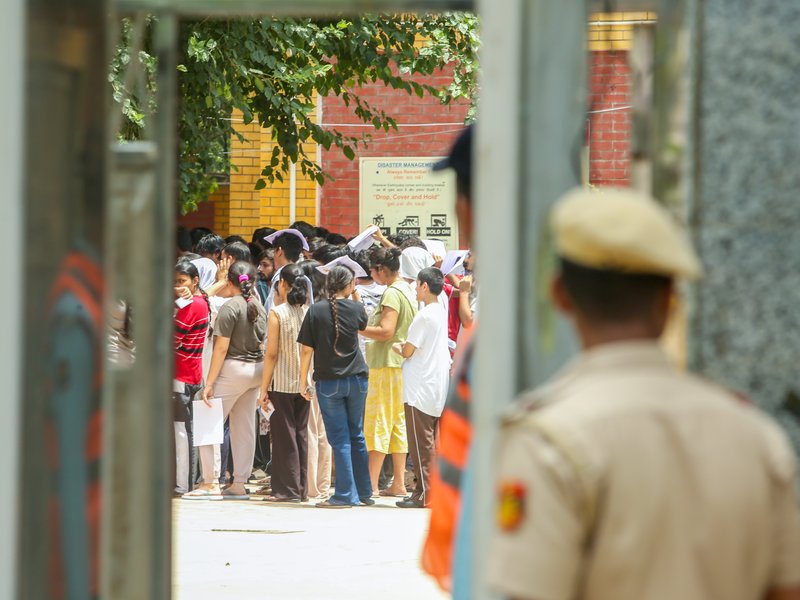
New Delhi, June 21 (IANS) National Eligibility-cum-Entrance Test (NEET-UG) 2026 re-examination was conducted across India and overseas on Sunday. There were massive security arrangements to ensure fair and smooth conduction of exam. It turned out to be one of the largest and most closely monitored examinations in the country's history.
The retest was held after the National Testing Agency (NTA) cancelled the original May 3 examination amid an ongoing probe into allegations of question paper leakage.
More than 22 lakh candidates appeared for the re-examination, which was conducted at 5,440 centres across 551 Indian cities and 14 overseas locations. The examination was held from 2 p.m. to 5.15 p.m., with additional compensatory time provided to eligible candidates with disabilities.
According to officials, Union Education Minister Dharmendra Pradhan kept monitoring the arrangements from the NTA headquarters in Delhi. He had earlier urged students to appear for the examination without anxiety.
According to the NTA, the nationwide exercise involved nearly seven lakh officials, including examination staff, police personnel and observers, while over 95,000 examination rooms were placed under CCTV surveillance through more than 1.38 lakh cameras. More than 51,000 signal jammers were also deployed to prevent electronic malpractice.
The re-examination was largely conducted peacefully across states. A common sentiment emerged from several regions that Biology was relatively easy and syllabus-based, Chemistry was moderate, while Physics proved to be the most challenging section.
In Telangana and Andhra Pradesh, where over 1.37 lakh students appeared at nearly 400 centres, candidates described Physics as difficult and time-consuming. Similar feedback came from Tamil Nadu, where around 1.42 lakh aspirants took the exam. Students in Chennai said Physics contained several analytical and numerical questions, making it tougher than the Biology and Chemistry sections.
In Gujarat, aspirants in Rajkot, Ahmedabad and Surat described Biology as manageable but found Physics and Chemistry comparatively challenging.
The examination also witnessed several instances highlighting both the logistical challenges and extraordinary support extended to candidates. In Kolkata, Shrishti Dubey, a student who suffered severe injuries in a road accident on June 14, was provided a separate examination room, medical supervision and a standby ambulance. According to officials, special arrangements were made after her family sought assistance from authorities.
Police personnel in Telangana also came to the rescue of candidates who mistakenly arrived at the wrong examination centres. In Hyderabad, officers personally escorted students to their correct venues to ensure they reached before the reporting deadline.
However, strict entry protocols led to disappointment for some candidates. In Bhopal, two students were denied entry after arriving late following a road accident. In Hyderabad, an emotional scene unfolded when a candidate who arrived after the 1.30 p.m. cutoff was not permitted to enter despite her father's repeated appeals to security personnel.
Heavy rainfall in Kolkata caused severe waterlogging and traffic disruptions, prompting many candidates to leave home early to avoid delays. In Mumbai, the Brihanmumbai Electric Supply and Transport (BEST) Undertaking operated special bus services to assist candidates amid an ongoing employees' strike. State transport corporations in Telangana and Andhra Pradesh also provided free travel facilities for examinees.
Authorities across states arranged drinking water, refreshments, medical facilities and waiting areas for parents and guardians outside examination centres. Candidates generally acknowledged that security arrangements were significantly tighter than during the earlier examination. Many felt the enhanced frisking, biometric verification and surveillance systems were necessary to restore confidence in the examination process.
In a detailed statement issued after the examination, the NTA described the re-test as a collective national effort involving multiple ministries, state governments, law enforcement agencies and educational institutions. The agency said special accommodations were made for more than 10,000 persons with disabilities and dozens of candidates with serious medical conditions.
--IANS
brt/pgh