
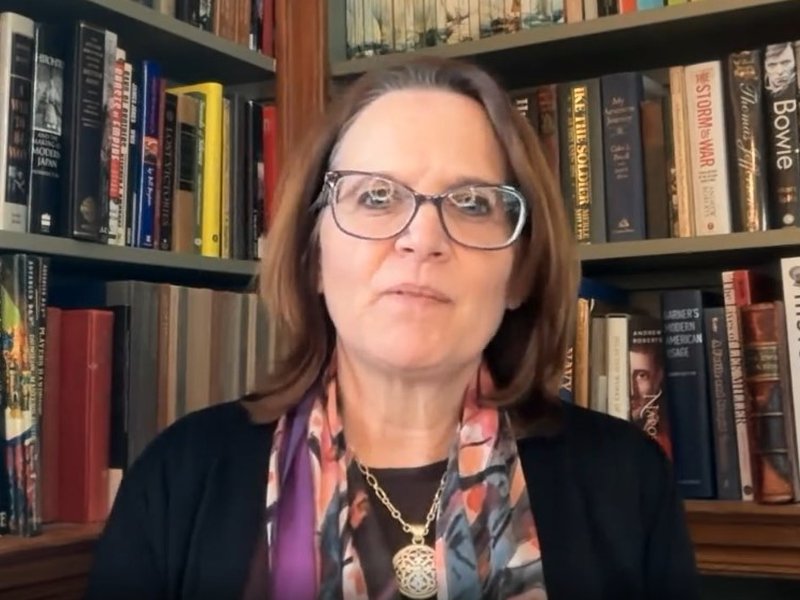

Washington, Feb 14 (IANS) Calling the outcome “a good day for Bangladeshi democracy,” former White House South Asia official Lisa Curtis said the largely peaceful conduct of Bangladesh’s elections offers hope, but warned that the rise of Jamaat-e-Islami and deep institutional damage leave “a lot of questions” ahead.
“Well, I think today is a good day for Bangladeshi democracy,” Curtis told IANS in an exclusive interview as the results of the elections showed a remarkable victory for the Bangladesh Nationalist Party and strong emergence of Jamaat-e-Islami.
“Despite fears that there would be a lot of violence on election day, they seem to have gone off without any major incidents of violence,” she said.
She noted that “70 per cent of Bangladesh also voted in favor of the referendum for reforming democratic institutions,” including “putting limits, term limits on the Prime Minister, increasing women’s participation in the Democratic process.” She described these as “very positive” developments.
At the same time, Curtis pointed out that voter turnout “was a little bit lower, I think, than usual. It was at 60 per cent.” She attributed this to the Awami League being “prohibited from being part of this election,” adding that “that’s the price that you had lower voter turnout because many of those Awami League voters stayed home.”
A major shift, she said, was the performance of Jamaat-e-Islami. “In past elections, the Jamaat-e-Islami traditionally only got five to 7 per cent of the vote. This time, it looks like they have won maybe over 68 seats in the legislature. So this is a big change for Bangladesh,” she said.
Curtis framed the key test ahead: “The big question is how are they gonna act as an opposition party?” She observed that while the party “really tried to appeal to younger voters during the election campaign,” it remains “controlled by the older generation of leaders, which means their policies are likely to remain conservative.”
“So I think that’s the big question. How is the Jamaat-e-Islami going to impact society and the way the country is governed?” she asked.
On the incoming prime minister, Tarique Rahman, Curtis was cautious but acknowledged the scale of expectations. “Well, I think he’s got a big job in front of him,” she said. “There’s been a lot of skepticism about him and past allegations of corruption. He’s been away from the country for 17 years.”
She stressed the urgency of institutional repair. “He has to do a lot to restore the people’s confidence in governance and in the democratic institutions. So much damage has been done to those institutions by the Sheikh Hasina government.”
“All eyes are now on him, how he’s gonna handle these challenges and how he’ll move the country forward,” she said, describing the moment as “a day of hope, but at the same time, the challenges in front of Bangladesh are immense.”
Turning to Washington’s response, Curtis said the United States would likely welcome the relatively peaceful conduct of the polls. “I think the US is probably pleased that the elections went off without a great deal of violence,” she said.
She added that “the US was critical in supporting the interim government when the interim government was trying to see the country through this very volatile time,” and that there is “a sense of relief in US policy circles that the election has gone forward relatively free of violence.”
However, she cautioned that Jamaat-e-Islami’s strengthened position could complicate matters. “There will be questions about this newfound power by the Jamaat-e-Islami. Their policies have been contradictory to everything the United States stands for, particularly on women.”
Curtis said Washington is likely to adopt “a wait and see approach” to assess how the BNP-led government “deals with the Jamaat-e-Islami.” She summed up the mood as: “Good day for democracy, but a lot of questions remain.”
On India’s response, Curtis suggested New Delhi initially misread the shifting political landscape. “Of course, New Delhi had put all its eggs in the Hasina basket and was unhappy to see her go,” she said.
She argued that “Indian officials were a little late to the game in terms of understanding where the country was going and how much damage Sheikh Hasina had done to the country and how much opposition there was to her.”
In recent months, however, she has seen a recalibration from India. “In the last couple of months, I think we have seen a change in New Delhi and its approach to the BNP,” she said, citing External Affairs Minister S. Jaishankar’s attendance at a funeral and meeting with the new leadership as evidence of outreach.
“While I think New Delhi’s a little late to the game, better late than never, they have recognised that there’s a new dispensation in Bangladesh,” Curtis said. She added that Bangladesh and India are “intertwined in so many ways,” making engagement inevitable. “It would be impossible for India not to deal with Bangladesh,” she said, expressing hope that the relationship would “smooth out in the coming months.”
Curtis currently serves as senior fellow and director of the Indo-Pacific Security Program at the Center for a New American Security. She previously served as deputy assistant to the US president and National Security Council senior director for South and Central Asia from 2017 to 2021, where she coordinated US policy on the Indo-Pacific and South Asia, including US-India strategic cooperation and the Quad framework.
--IANS
lkj/rs